
Way Forward: an Indigenous approach to well-being

Objective: Aboriginal and Torres Strait Islander individuals are overrepresented in mental health services in the state of Queensland (QLD), Australia; indicating greater prevalence and less preventative management of mental illness. This paper describes a project to enhance the model of care to improve mental health, alcohol and other drug outcomes for Aboriginal and Torres Strait […]
Racial Bias in Health Care and Health: Challenges and Opportunities

This Viewpoint describes the contribution of racial bias to disparities in health care and discusses the need to increase awareness of disparities and work toward eliminating discrimination and its adverse effects. A landmark report from the Institute of Medicine (IOM) in 2003 documented that from the simplest to the most technologically advanced diagnostic and therapeutic […]
What constitutes benefit from health care interventions for Indigenous Australians?

The health of Indigenous Australians is poor compared to that of their counterpart Australians. Further, their health is worse by international standards. The Australian Government recently made a commitment to improving the health status of Indigenous Australians through the ‘closing the health gap’ initiative. Achieving this requires an improvement in the priority setting process through […]
Developing a best practice pathway to support improvements in Indigenous Australians’ mental health and well-being: a qualitative study

Objective There is a need to adapt pathways to care to promote access to mental health services for Indigenous people in Australia. This study explored Indigenous community and service provider perspectives of well-being and ways to promote access to care for Indigenous people at risk of depressive illness. Design A participatory action research framework was […]
Like drawing into sand’: acceptability, feasibility, and appropriateness of a new e-mental health resource for service providers working with Aboriginal and Torres Strait Islander people

Cross-cultural considerations and difficulties recruiting and retaining skilled workers in rural and remote regions may contribute to poorer service use for Aboriginal and Torres Strait Islander people. However, electronic resources may provide the opportunity for remote workforces to deliver structured, evidence-based, culturally appropriate treatments with limited training burden. The aim was to develop and determine […]
A tertiary approach to improving equity in health: quantitative analysis of the Māori and Pacific Admission Scheme (MAPAS) process, 2008–2012

Introduction Achieving health equity for indigenous and ethnic minority populations requires the development of an ethnically diverse health workforce. This study explores a tertiary admission programme targeting Māori and Pacific applicants to nursing, pharmacy and health sciences (a precursor to medicine) at the University of Auckland (UoA), Aotearoa New Zealand (NZ). Application of cognitive and […]
The value of partnerships: lessons from a multi-site evaluation of a national social and emotional wellbeing program for Indigenous youth

Objective: To evaluate the first three years of a national program to improve the social and emotional wellbeing of Indigenous youth in remote and regional Australia. Methods: Combination of open inquiry and audit review involving investigation of process and outcomes, with a broad national overview supplemented by five in-depth case studies in diverse settings. Results: […]
Decolonising Australian psychology: discourses, strategies and practice

Arnhem Land community-driven mental health program being used as case study for rest of country

A community-driven mental health program in an Arnhem Land Indigenous community is being held up as a case study for the rest of Australia. A small local team has been running the program at Galiwin’ku on Elcho Island for the past eight years, which has included support for the community in the aftermath of two […]
Aboriginal health promotion through addressing employment discrimination

The Localities Embracing and Accepting Diversity (LEAD) program aimed to improve the mental health of Aboriginal Victorians by addressing racial discrimination and facilitating social and economic participation. As part of LEAD, Whittlesea Council adopted the Aboriginal Employment Pathways Strategy (AEPS) to increase Aboriginal employment and retention within the organisation. The Aboriginal Cultural Awareness Training Program […]
“You’ve got to make it relevant”: barriers and ways forward for assessing cognition in Aboriginal clients

Background: Reliable cognitive assessment for non-western cultures is difficult given that mainstream tests typically rely on western concepts, content and values. Despite recognition of the scarcity of appropriate tests for Aboriginal people over many years, limited practical development has occurred. This study aimed to identify barriers to assessment for clinicians working with Aboriginal people in […]
Experiencing racism in health care: the mental health impacts for Victorian Aboriginal communities

Cultural respect strategies in Australian Aboriginal primary health care services: beyond education and training of practitioners

Objective: There is little literature on health-service-level strategies for culturally respectful care to Aboriginal and Torres Strait Islander Australians. We conducted two case studies, which involved one Aboriginal community controlled health care service and one state government-managed primary health care service, to examine cultural respect strategies, client experiences and barriers to cultural respect. Methods: Data […]
A model for large-scale, interprofessional, compulsory cross-cultural education with an Indigenous focus

Cultural competency training for health professionals is now a recognised strategy to address health disparities between minority and white populations in Western nations. In Australia, urgent action is required to “Close the Gap” between the health outcomes of Indigenous Australians and the dominant European population, and significantly, cultural competency development for health professionals has been […]
Attraction, recruitment and distribution of health professionals in rural and remote Australia: early results of the Rural Health Professionals Program

Abstract Background: Australians living in rural and remote communities experience relatively poor health status in comparison to the wider Australian population (Med J Aust 185:37-38, 2006). This can be attributed in part to issues of access to health services arising from difficulties in recruiting and retaining health professionals in these areas. The Rural Health Professionals […]
Religiosity, spirituality, mental health,and mental health treatment outcomes in Australia: a systematic literature review

The relationship between religiosity and mental health is a relatively well-researched field within North America, covering numerous domains of religiosity, including: religion, spirituality, prayer, church attendance, church affiliation and belief in God or a higher power. Considering the Australian literature, there are few papers that explore these dimensions of religiosity and their relationship with health, […]
Implementing an Intercultural Psychology Undergraduate Unit: Approach, Strategies, and Outcomes
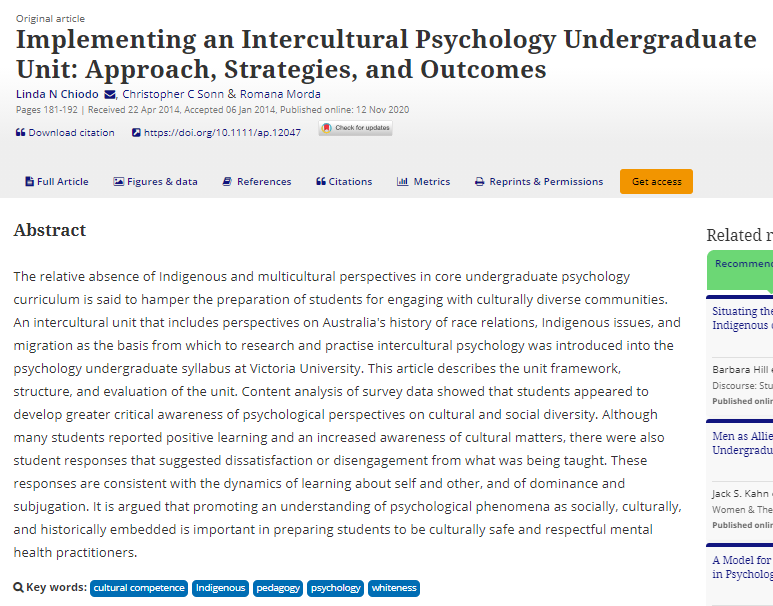
The relative absence of Indigenous and multicultural perspectives in core undergraduate psychology curriculum is said to hamper the preparation of students for engaging with culturally diverse communities. An intercultural unit that includes perspectives on Australia’s history of race relations, Indigenous issues, and migration as the basis from which to research and practise intercultural psychology was […]
Are We Asking the Right Questions? Why We Should Have a Decolonzing Discourse Based on Conscientization Rather Than Indigenizing the Curriculum

In this paper, we pose the question of terminology and definitions associated with the concept of an indigenized academy or curriculum. Calls to indigenze the academy or curriculum are implicitly asking for an overlay or inclusion of Indigenous content, preferably by Indigenous peoples, as a mechanism to incorporate histories, traditions, and knowledges that are divergent […]
The role of traditional medicine practice in primary health care within Aboriginal Australia: a review of the literature

The practice of traditional Aboriginal medicine within Australia is at risk of being lost due to the impact of colonisation. Displacement of people from traditional lands as well as changes in family structures affecting passing on of cultural knowledge are two major examples of this impact. Prior to colonisation traditional forms of healing, such as […]
Critical psychology in a context of ongoing acts of colonisation

Although encompassing a broad range of topic areas, approaches to analysis, and theoretical frameworks, it is arguably the case that critical psychology in Australia is best represented by research undertaken on the topic of racism. The primary reason why critical research on racism has been so prevalent in Australia, is because of the ongoing history […]
Developing an exploratory framework linking Australian Aboriginal peoples’ connection to Country and concepts of wellbeing

Aboriginal people across Australia suffer significant health inequalities compared with the non-Indigenous population. Evidence indicates that inroads can be made to reduce these inequalities by better understanding social and cultural determinants of health, applying holistic notions of health and developing less rigid definitions of wellbeing. The following article draws on qualitative research on Victorian Aboriginal […]
Teaching intercultural competencies in introductory psychology via application of the excellence in cultural experiential learning and leadership model

This article describes a pilot evaluation involving teaching and learning activities focussed on developing intercultural competencies in an undergraduate psychology unit. Specifically, first year psychology students engaged in two tasks derived from the alliance building and cultural mapping methods of an existing intercultural training resource—the Excellence in Cultural Experiential Learning and Leadership (EXCELL; Mak, Westwood, […]
No time like the present: Determinants of intentions to engage In bystander anti-racism on behalf of indigenous Australians

Working in Indigenous contexts: self-reported experiences of non-Indigenous psychologists

Despite assertions in the literature that psychologists adopt culturally inappropriate strategies for working with Indigenous clients, there is little empirical evidence about this. The aim of this study was to document the self-reported experiences of non-Indigenous psychologists working with Indigenous clients, the factors that they felt constrain these interactions, and the clinical, assessment and communication […]
Reducing the health disparities of Indigenous Australians: time to change focus

Background: Indigenous peoples have worse health than non-Indigenous, are over-represented amongst the poor and disadvantaged, have lower life expectancies, and success in improving disparities is limited. To address this, research usually focuses on disadvantaged and marginalised groups, offering only partial understanding of influences underpinning slow progress. Critical analysis is also required of those with the […]