
Layered spaces: a pedagogy of uncomfortable reflexivity in Indigenous education

University disciplines are grappling with how best to incorporate Indigenous content and frameworks for practice into their teaching to better prepare graduates to work with Indigenous communities. Yet the pedagogical approaches that can best engage students in Indigenous Studies as a field of critical study are still being debated. This article has two aims. The […]
Working at a cultural interface: co-creating Aboriginal health curriculum for health professions

Historical exclusion of Aboriginal people and Aboriginal epistemologies in Australian higher education, including health professions education, has produced generations of healthcare professionals who are ill-equipped and lack confidence to provide culturally safe care for Aboriginal communities. This article recounts efforts undertaken at a university in Melbourne to foreground Aboriginal ways of knowing and being through […]
Traditional medicine plays a role alongside Western medicine

Indigenous cultures have successfully used traditional healers and bush medicine for thousands of years. Many of these practices continue to be used today. When dealing with Indigenous patients, it will help you to be aware of these practices and to understand why they are important to Indigenous Australians. You’ll also have the opportunity to learn […]
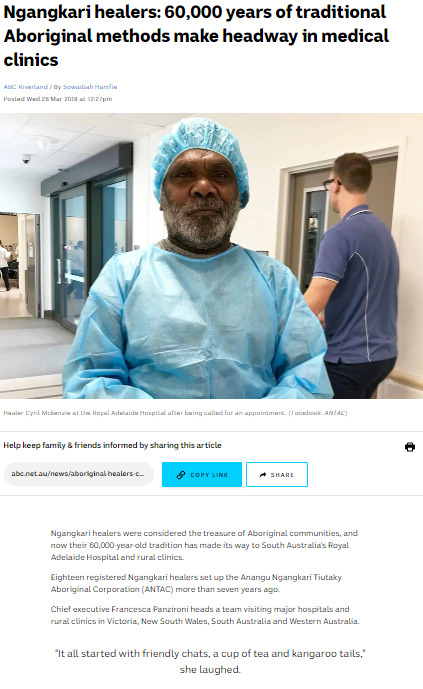
Ngangkari healers: 60,000 years of traditional Aboriginal methods make headway in medical clinics
Community Healing

For Aboriginal and Torres Strait Islander people, healing is a holistic process, which addresses mental, physical, emotional and spiritual needs and involves connections to culture, family and land. Healing works best when solutions are culturally strong, developed and driven at the local level, and led by Aboriginal and Torres Strait Islander people.
This New Short Film Details The Horrors Of Indigenous Displacement & Incarceration First-Hand

With NAIDOC Week observances ongoing for 2021, important spotlights are being placed on the issues and systemic under-privileges that face First Nations people from the moment they are born. And thanks to a brand new short film, the first-hand horrors of displacement and a youth spent slipping through the cracks have been laid bare.
Ngangkari – Traditional Healers

Ngangkari are the traditional healers of the Ngaanyatjarra, Pitjantjatjara and Yankunytjatjara (NPY) lands in the remote western desert of Central Australia. Ngangkari have looked after people’s physical and emotional health for thousands of years. The NPY Women’s Council Ngangkari Program supports ngangkari to continue their work in communities, clinics and hospitals.
How an Aboriginal approach to mental health is helping farmers deal with drought

Psychological tools developed with Aboriginal people can also support Australian farmers whose land is suffering the effects of climate change.
Partnership for Justice in Health: Scoping Paper on Race, Racism and the Australian Health System

This discussion paper was first prepared as a scoping paper designed to assist the Partnership for Justice in Health (P4JH) consider what is offered by existing scholarship about race and racism in the health system, and in particular, to identify a research approach to support the Australian Government’s National Aboriginal and Torres Strait Islander Health […]
The Role of Psychologists in a Changing Time

This is the third video in a three-part video series and collaboration between the Transforming Indigenous Mental Health and Wellbeing project and Pearson Australia. This dynamic three-part video series provides foundational learning about Aboriginal and Torres Strait Islander cultural knowledges, and explores contemporary global issues, such as the Black Lives Matter movement. Together, the video […]
Kaartajin Ngundabut Indigenous Cultural Knowledge

This is the second video in a three-part video series and collaboration between the Transforming Indigenous Mental Health and Wellbeing project and Pearson Australia. This dynamic three-part video series provides foundational learning about Aboriginal and Torres Strait Islander cultural knowledges, and explores contemporary global issues, such as the Black Lives Matter movement. Together, the video […]
Introduction to Indigenous Psychology

This is the first video in a three-part video series and collaboration between the Transforming Indigenous Mental Health and Wellbeing project and Pearson Australia. This dynamic three-part video series provides foundational learning about Aboriginal and Torres Strait Islander cultural knowledges, and explores contemporary global issues, such as the Black Lives Matter movement. Together, the video […]
Aboriginal and Torres Strait Islander Health in General Practice: An introduction to teaching and learning

This guide sets out how GP Supervisors can strengthen teaching and learning about Aboriginal and Torres Strait Islander health.
An introduction to Aboriginal and Torres Strait Islander health cultural protocols and perspectives
This document provides a guide to appropriate and respectful behaviour with Aboriginal and Torres Strait Islander people. It is intended to give RACGP members and staff background information and guidance on Aboriginal and Torres Strait Islander perspectives, along with an understanding of important protocols and other relevant cultural issues. It can be used to guide […]
Healing through voice, culture and Country: Short films

This resource will benefit practitioners in mainstream health, education and social and community services who work with Aboriginal and Torres Strait Islander families experiencing FDV.
Ausplat Conference: 17-19 September 2021

The following document provides links to access the Ausplat (Australian Psychology Learning and Teaching) conference presentations, held in September 2021. Several of these presentations related to Aboriginal and Torres Strait Islander Knowledges and Psychology Education (see page 3).
Cultural humility and decolonial practice: narratives of therapists’ lives
Objective: Cultural competence has been critiqued as a flawed principle, focussed on mastery of cultural knowledge rather than critical reflection on race and privilege. Cultural humility is proposed as an alternative, emphasising accountability over mastery, involving critical self-reflection of personal biases and culture. This study aims to explore the development of cultural humility in psychological […]
Facilitating Sustainable Disaster Risk Reduction in Indigenous Communities: Reviving Indigenous Worldviews, Knowledge and Practices through Two-Way Partnering

The Sendai Framework of Action 2015–2030 calls for holistic Indigenous disaster risk reduction (DRR) research. Responding to this call, we synergized a holistic philosophical framework (comprising ecological systems theory, symbolic interactionism, and intersectionality) and social constructionist grounded theory and ethnography within a critical Indigenous research paradigm as a methodology for exploring how diverse individual and […]
Synergy of systems theory and symbolic interactionism: a passageway for non-Indigenous researchers that facilitates better understanding Indigenous worldviews and knowledges

Historically, non-Indigenous researchers have contributed to colonisation by research based on Western positivistic philosophical frameworks. This approach led to disembodying knowledge from Indigenous people’s histories, worldviews, and cultural and social practices, thus perpetuating a deficit-based discourse which situates the responsibility of problems within Indigenous peoples and ignores the larger socio-economic and historical contexts in which […]
AIATSIS Code of Ethics for Aboriginal and Torres Strait Islander Research

What Contributions, if Any, Can Non-Indigenous Researchers Offer Toward Decolonizing Health Research?

Four non-Indigenous academics share lessons learned through our reflective processes while working with Indigenous Australian partners on a health research project. We foregrounded reflexivity in our work to raise consciousness regarding how colonizing mindsets-that do not privilege Indigenous ways of knowing or recognize Indigenous land and sovereignty-exist within ourselves and the institutions within which we […]
Aboriginal Participatory Action Research: An Indigenous Research Methodology Strengthening Decolonisation and Social and Emotional Wellbeing

This discussion paper explicates the concepts and application of a critically reflexive and transformative Indigenous Research Methodology (IRM) — Aboriginal Participatory Action Research (APAR) — designed to centre and increase Indigenous voice and ‘epistemic self-determination’ in Indigenous research and psychology. The intent is to justify and legitimate Indigenous knowledges and methodologies as authentic, rightful, valued, […]
Contributions to urban Indigenous self-determination: The story of Neeginan and Kaupapa Māori
This paper considers two different Indigenous-led initiatives, the Neeginan initiative (Winnipeg, Canada) and the Kaupapa Māori movement (New Zealand), within the context of urban Indigenous self-determination, examining the role, or contributions of, each towards the realisation of Indigenous self-determination. Neeginan originates from, and focuses on, building a sense of community, through education programs, social assistance […]
Relationally Responsive Standpoint

This paper is a commentary responding to the problem of Indigenous post-graduate students and scholars struggling with an understanding of Indigenous Standpoint Theory and either disengaging with it or including it in shallow or tokenistic ways that fail to advance knowledge in this emergent field (Foley, 2018). A framework grounded in respectful protocol is suggested […]
Decolonising clinical psychology: National and international perspectives

Background Throughout the 19th and 20th Centuries psychology has been used as a tool of colonisation. Critical theorists argue that in order to improve the wellbeing of those most affected by inequality, psychology programs need to be decolonised. In the Australian context, research has primarily focused on what decolonised curricula might look (e.g., Dudgeon 2017; […]