
Colonisation, racism and Indigenous health

In settler-colonies such as Canada, Australia, New Zealand and the United States, the historical impacts of colonisation on the health, social, economic and cultural experiences of Indigenous peoples are well documented. However, despite being a commonly deployed trope, there has been scant attention paid to precisely how colonial processes contribute to contemporary disparities in health […]
Australian Indigenous Psychology Education Project Curriculum Framework

The objective of the AIPEP Curriculum Framework is to ensure Aboriginal and Torres Strait Islander knowledges are embedded within undergraduate and postgraduate level psychology education.
Australian Indigenous Psychology Education Project Workforce Capabilities Framework
The objective of the AIPEP Workforce Capabilities Framework is to document the knowledge, skills and values required of psychologists working with Aboriginal and Torres Strait Islander peoples in order to build the capacity and competency of all psychology graduates to work appropriately and effectively with Aboriginal and Torres Strait Islander peoples.
Australian Indigenous Psychology Education Project Guidelines for Increasing the Recruitment, Retention and Graduation of Aboriginal and Torres Strait Islander Psychology Students

AIPEP Guidelines for Increasing the Recruitment, Retention and Graduation of Aboriginal and Torres Strait Islander Psychology Students.
Gambay – Languages Map

First Languages Australia is working with regional language centres nationally to develop a map of Australian languages that reflects the names and groupings favoured by community. Regional language centres have provided updated maps for their regions to be collated into this interactive map of languages and language families. Some regions have choosen to show related […]
The Study of Environment on Aboriginal Resilience and Child Health (SEARCH): a long-term platform for closing the gap

The full potential for research to improve Aboriginal health has not yet been realised. This paper describes an established long-term action partnership between Aboriginal Community Controlled Health Services (ACCHSs), the Aboriginal Health and Medical Research Council of New South Wales (AH&MRC), researchers and the Sax Institute, which is committed to using high-quality data to bring […]
First languages Australia

First Languages Australia works to ensure that the wishes of Aboriginal and Torres Strait Islander community members are voiced in key decision-making processes that impact on the current and future management of their languages. This will in turn shape the survival of Australia’s traditional languages into the future. The organisation facilitates discussions between communities and […]
Improving healthcare for Aboriginal Australians through effective engagement between community and health services
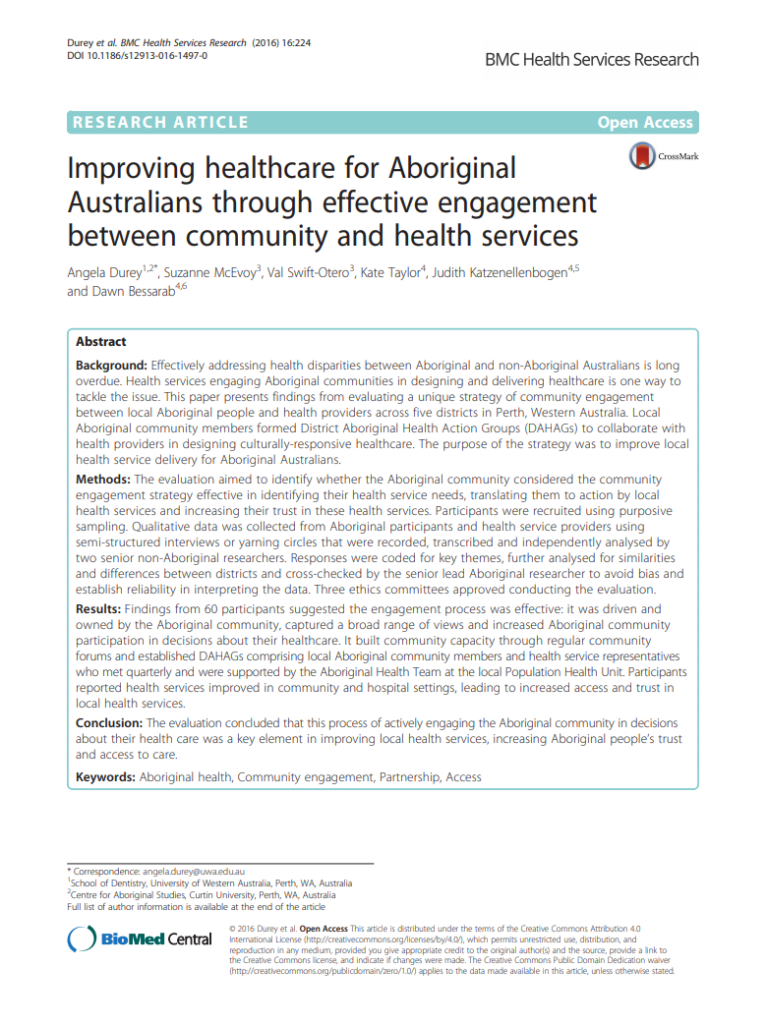
Background Effectively addressing health disparities between Aboriginal and non-Aboriginal Australians is long overdue. Health services engaging Aboriginal communities in designing and delivering healthcare is one way to tackle the issue. This paper presents findings from evaluating a unique strategy of community engagement between local Aboriginal people and health providers across five districts in Perth, Western […]
Healing for Our Stolen Generations: sharing our stories

This report is a review of the first two years of projects funded under the Healing Foundation’s Stolen Generations Initiative 2013-2015.
Achieving stability for Aboriginal and Torres Strait Islander children in out-of-home care – SNAICC Policy Position Statement

SNAICC and many of its members have been watching with concern as, around the country, a range of processes are undertaken to progress longer-term care arrangements for children. They vary in detail but have been broadly described as permanency planning measures. Some of these proposals have already taken the form of legislative changes (NSW, Vic. […]
The Jekkora group: an Aboriginal model of early identification, and support of persons with psychological distress and suicidal ideation in rural communities

Objective: To describe a community developed Aboriginal model for early identification and referral of people with psychological distress and suicidal ideation. Method: A description of an Aboriginal mental health service model is presented, as established at the Njernda Aboriginal Corporation, Echuca, Victoria. Results: The model is presented under five headings: Setting; Recruitment and appointment of […]
What works in Aboriginal and Torres Strait Islander suicide prevention?

Suicide is a complex behaviour with many causes. For Aboriginal and Torres Strait Islander peoples there are specific cultural, historical, and political considerations that contribute to the high prevalence, and that require the rethinking of conventional models and assumptions.
Unsettling Australian settler supremacy: combating resistance in university Aboriginal studies

Higher education courses designed to equip students to work effectively with Indigenous peoples by teaching about racism and inequality often encounter resistance to these concepts. In particular, students argue that individual and structural racisms, and their own white privilege, are ‘not their fault’. This article examines different forms of student resistance expressed within a number […]
Aboriginal and Torres Strait Islander health and well-being: implications for a cognitive behavioural therapy framework

Objective: It has been acknowledged that the mental health of Aboriginal and Torres Strait Islander people has been “bedeviled” by the inappropriate application of non-Indigenous models of mental health. To enhance Indigenous health and well-being it is necessary for non-Indigenous practitioners to find a culturally safe way to enter the negotiated space of cross-cultural mental […]
‘We’re checking them out’: Indigenous and non-Indigenous research participants’ accounts of deciding to be involved in research

Background: It is important for researchers to understand the motivations and decision-making processes of participants who take part in their research. This enables robust informed consent and promotes research that meets the needs and expectations of the community. It is particularly vital when working with Indigenous communities, where there is a history of exploitative research […]
Australian Medical Association 2015 Report card on Indigenous Health

Traditional Aboriginal Healing & Western Medicine, The Missing Gap
The sixth Slice of LIME Seminar was hosted by the Poche Indigenous Health Network in Sydney, on Thursday 28th April 2016. Do we need traditional Aboriginal medicine working with western medicine to close the gap? This Close the Gap forum considered the health maintenance and traditional healing practices of Aboriginal Ngangkari in western medicine. Could […]
Increasing cultural competence and Indigenous representation in psychology

Reflections on what has/has not worked for Psychology Educators. This document was developed for the Australian Indigenous Psychology Education Project (AIPEP) ‘How To’ forum held at the APS Golden Jubilee Conference, September 2015. It provides brief points on what has and has not worked for psychology educators involved in the project when attempting to implement […]
Finding Common Ground – Avoiding the Terminology Trap

The fourth Slice of LIME Seminar was held on 27th April 2015, hosted by the University of Sydney. This event was a Poche Indigenous Health Network Key Thinkers Forum and a National Senior Teaching Fellowship activity, supported by the Office of Learning and Teaching. The forum focused on identifying and applying critical elements of cultural […]
Indigenising the Psychology Curriculum – Traps and Tips

An easy to read spreadsheet listing traps, tips, and resources for psychology educators in the process of Indigensing the psychology curriculum. This document is a work in progress, all feedback and suggestions are welcomed.
Aboriginal Children and Young People Speak Out

Since 2007, Aboriginal children and young people have participated in a range of the Commissioner’s consultation projects on topics such as wellbeing, mental health and alcohol-related harm. Additionally, the Commissioner has consulted with Aboriginal children and young people, their families and communities, during many visits to regional and remote communities from Kununurra to Albany and […]
Rising Spirits Community Resilience Project – Final Research Report

The Rising Spirits Project investigated what supports Aboriginal people need during bereavement, what is available that is being utilised by Aboriginal people, where the gaps are and the levels of community and state readiness to address grief and loss.
Cultural competency in the delivery of health services for Indigenous people

This review aims to examine available evidence on cultural competence in health care settings to identify key approaches and strategies that can contribute to improving the development and implementation of Indigenous health services and programs.
Development and validation of the Australian Aboriginal racial identity and self-esteem survey for 8–12 year old children (IRISE_C)

Introduction: In Australia, there is little empirical research of the racial identity of Indigenous children and youth as the majority of the current literature focuses on adults. Furthermore, there are no instruments developed with cultural appropriateness when exploring the identity and self-esteem of the Australian Aboriginal population, especially children. The IRISE_C (Racial Identity and Self-Esteem […]
The Stolen Generations: The forced removal of First Peoples children in Australia

This chapter considers the removal of Indigenous children as a global colonial and neocolonial tactic. The history of the Australian Stolen Generations is focused on, from the beginning of the abduction of children in the early 1900s up until 2015. The landmark 1997 Bringing Them Home: Report of the National Inquiry into the Separation of […]