
Adopting an Indigenous rights-based approach to working with Aboriginal and Torres Strait Islander students: Repositioning school psychology to address Competency 8
This paper examines the emerging professional expectation that school psychologists will be able to demonstrate competency in delivering services to Indigenous students. We argue that achieving this competency requires an underpinning Indigenous rights-based perspective embedded in professional education and practice. We discuss the historical context of psychology in Australia, the competencies needed for psychologists and […]
Systemic Racism and Oppression in Psychology: Voices from Psychologists, Academic Staff, and Students
Psychology must reassess its training approach, as the current monocultural paradigm not only causes harm, but also fails to equip psychologists with the knowledge needed to provide culturally appropriate care for Māori, Pacific, Asian, and other minoritised groups. Findings from this report contribute to the growing evidence of the urgent need to address barriers preventing […]
Māori-focused Course Content in Undergraduate Psychology Programmes in Aotearoa New Zealand
Despite consistent critiques of the psychology discipline for over 40 years there has been insufficient inclusion of Māori worldviews in tertiary learning environments, and we still do not have a comprehensive curriculum that can prepare psychology graduates to work with Māori. Out of 141 courses offered in 2022 that we assessed, only two (1.4%) were […]
Marginalisation, Migration, and Movement: Responding to the Underrepresentation of Māori in the Clinical Psychology Workforce in Aotearoa New Zealand
Within Aotearoa, the shift towards an Indigenously grounded psychology continues with great excitement and caution. An over-reliance on epistemologies, research, and practice based on Western, educated, industrialised, rich and democratic (WEIRD) societies remains a barrier to achieving this. To understand the growth of the clinical psychology workforce and the Māori workforce, Manatū Hauora, Ministry of […]
Aboriginal psychology and reform at the University of Sydney: steps towards structural change
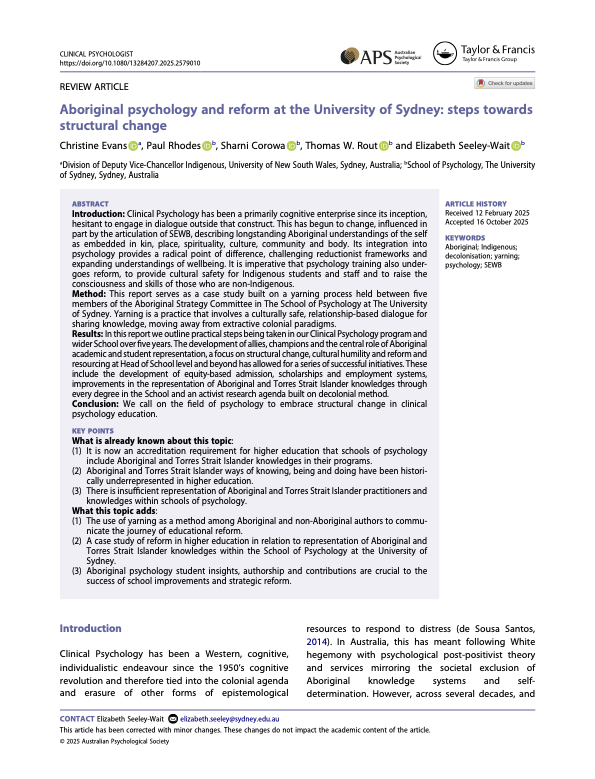
Introduction Clinical Psychology has been a primarily cognitive enterprise since its inception, hesitant to engage in dialogue outside that construct. This has begun to change, influenced in part by the articulation of SEWB, describing longstanding Aboriginal understandings of the self as embedded in kin, place, spirituality, culture, community and body. Its integration into psychology provides […]
Considering cultural responsiveness in the creation of the International Competences for Undergraduate Psychology (ICUP) model: What can psychology learn

This article aims to describe the development of foundational competencies relevant to cultural responsiveness (CR), within the context of the International Competences for Undergraduate Psychology (ICUP) model (Nolan et al., 2025). The underlying premise of the ICUP model is that the acquisition of undergraduate-level foundational psychology competences can and should have high value in personal, work, […]
A Framework to Enact Competency 8 Through an Indigenous Rights-based Approach in School Psychology
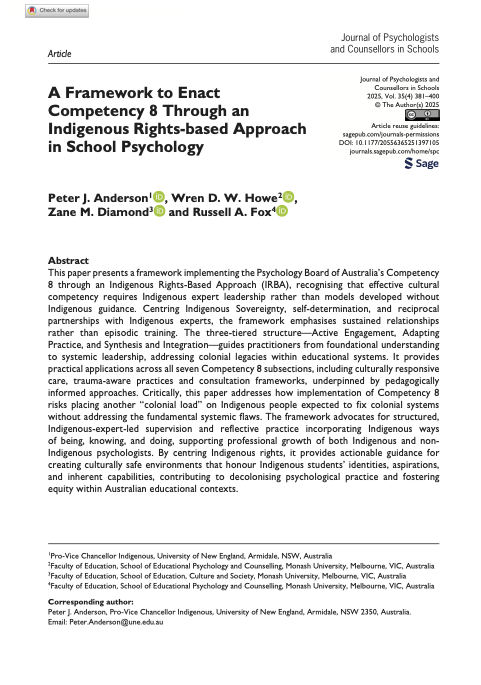
This paper presents a framework implementing the Psychology Board of Australia’s Competency 8 through an Indigenous Rights-Based Approach (IRBA), recognising that effective cultural competency requires Indigenous expert leadership rather than models developed without Indigenous guidance. Centring Indigenous Sovereignty, self-determination, and reciprocal partnerships with Indigenous experts, the framework emphasises sustained relationships rather than episodic training. The […]
Hearing Australian Aboriginal stories to develop recommendations towards improving the psychology discipline: an Indigenous yarning methodological perspective.

The dominant western scientific methodology and standards are being challenged by a global academic push by Indigenous peoples to preference the use of culturally informed and appropriate Indigenous methodologies to produce collective benefits for communities. This article describes a methodology grounded by an Indigenous research paradigm, embodied through an Indigenous standpoint lens, and underpinned by […]
Decolonizing psychology education in Australia through the Australian Indigenous Psychology Education Project

There is a critical need for Indigenous knowledges in psychology as a matter of epistemic justice and achieving health equity for Aboriginal and Torres Strait Islander peoples. In Australia, Indigenous psychologists are at the forefront of the decolonizing psychology movement by challenging the Western hegemony and privileging Indigenous knowledges in psychology. Situated within this movement, […]
Decolonial psychology: Academic and activist perspectives
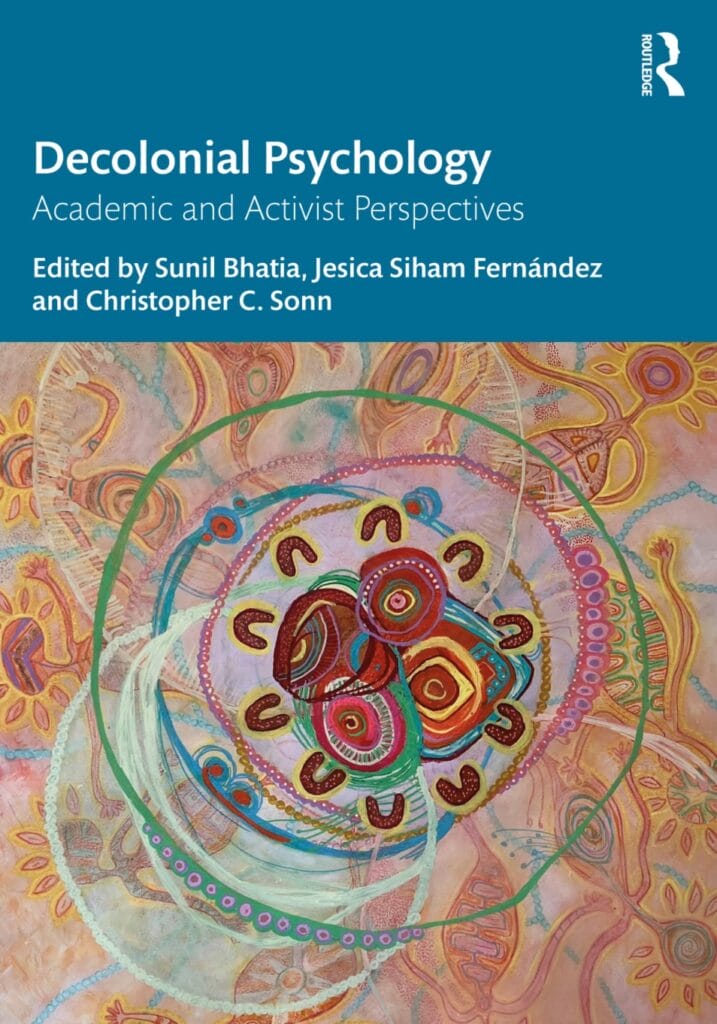
This cutting-edge book re-imagines what a truly decolonial psychology could look like. It explores questions of what counts as psychological knowledge and whose knowledge is valid, and who controls the production of knowledge in psychology. This book builds on the expanding knowledge base in decolonial psychology to meaningfully address the varied social and psychological trajectories […]
wangii wadhan biyay–Baskets of Listening and Respect
This chapter offers a meeting place (ganma) between Indigenous Australian knowledges and Western psychological practice; a framework for respectful, inclusive praxis that honours deep-time realisations and decolonises psychology by critically examining Eurocentric dominance and oppression. wangii wadhan biyay (baskets of listening and respect, Dhurga language) offers seven baskets of knowledge layers that must be in […]
Embracing Social and Emotional Wellbeing Can Create Transformational Change in Psychology
Aboriginal and Torres Strait Islander peoples are one of the oldest continuous living cultures in the world, with knowledge systems that promote harmonious collective wellbeing. Colonialism, including the historical role of imposed Western knowledges such as psychology, disrupted these knowledges. This caused devastating effects to the wellbeing of Aboriginal and Torres Strait Islander peoples. Today, […]
The contribution of evidence-based practice and the practice-based evidence approaches to contemporary Australian psychology: implications for culturally safe practice

Psychological practice emphasises the importance of using the best available evidence to ensure accountability and promote positive outcomes for individuals and communities. These expectations are critical for community trust; however, without adequate consideration of broader processes of knowledge production, this focus can marginalise populations and perpetuate health inequities, such as those experienced by Aboriginal and […]
Decolonising tertiary psychology programs in Australia: privileging Aboriginal and Torres Strait Islander peoples’ voices

Objective The Australian Indigenous Psychology Education Program has paved the way for Indigenising and decolonising psychology programs. While Indigenisation and decolonisation of psychology programs are not yet consistent, exemplar initiatives have emerged within recent times. This paper showcases these exemplars, providing details about the “how to” privilege Indigenous knowledges and decolonising practices. Method A qualitative […]
Decolonising tertiary psychology education in Australia: Processes, challenges and opportunities of curricula change

Australian psychology higher education and training has historically excluded Aboriginal and Torres Strait Islander peoples’ knowledge systems which has profoundly shaped the discipline, including its cultural responsiveness. Decolonising psychology education offers a systemic approach to improve education and practice, and, in turn, the cultural responsiveness of psychology. Decolonising psychology higher education has become a focal […]
AIPEP Learning Resource: Working Together and the Psychology Board of Australia Professional Competencies for Psychology – Competency 8 Resource Map

The AIPEP Learning Resources aims to support Ahpra registered psychologists build their capacity to meet Psychology Board of Australia’s Professional Competency 8: Demonstrates a health equity and human rights approach when working with Aboriginal and Torres Strait Islander peoples. This online resource maps chapters from the Working Together (2014) textbook against the Psychology Board of […]
AIPEP Learning Resource: Psychology Board of Australia Professional Competencies for Psychology – Competency 8 Resource Map

The AIPEP Learning Resources aims to support Ahpra registered psychologists build their capacity to meet Psychology Board of Australia’s Professional Competency 8: Demonstrates a health equity and human rights approach when working with Aboriginal and Torres Strait Islander peoples. This online resource maps a wide range of Indigenous-led publications against Competency 8 sub competencies. Readers will […]
Yarning sessions to facilitate cultural responsiveness and decolonising the curriculum in a university psychology setting

Psychology higher education providers play a critical role in growing a culturally safe psychology workforce by engaging in culturally responsive practices, embedding Indigenous perspectives and decolonising curricula. We describe yarning sessions that aimed to facilitate collective learning, reflexivity and decolonising praxis. They were led through relationship and governance from the Australian Indigenous Psychology Education Project […]
Indigenous psychology in Australia

Experiences of colonial oppression have had a profound and enduring effect on the wellbeing of Aboriginal and Torres Strait Islander people, and communities throughout Australia and other indigenous nations globally. On almost every headline, indicator statistics show that Aboriginal and Torres Strait Islander people fare worse than their non-Indigenous counterparts. Australian psychology has been implicated […]
Decolonising tertiary psychology student support in Australia: empowering Aboriginal and Torres Strait Islander psychology students

Objective Aboriginal and Torres Strait Islander people, including psychologists, are actively leading and decolonising psychology. The focus of decolonising psychology is on epistemic justice for Indigenous knowledges and delivering culturally responsive services. Indigenous psychologists play a vital role in the decolonising process. Despite recommendations and initiatives aimed at decolonising psychology tertiary programs, such as increasing […]
Toward culturally responsive psychology higher education courses: psychologists’ perspectives on preparedness to work with Aboriginal and Torres Strait Islander clients

Background Psychology course regulatory standards for Australian universities have evolved in that universities are required to include cultural responsiveness in psychology curriculum and demonstrate graduate competencies for working with Aboriginal and Torres Strait Islander clients. Aim This study aimed to explore psychologists’ perspectives about the higher education (HE) psychology curriculum in relation to their preparedness […]
Working Together in Psychology Higher Education

Dr. Stacey McMullen, Professor Monica Thielking, Professor Jeneva Ohan and Ms Belle Selkirk discussing the significance of the Working Together book in psychology higher education and how they’ve used it throughout their careers as educators and psychologists. This event was part of a series of webinars commemorating the tenth anniversary of the seminal text book, […]
Untying Settler-Colonial Knots in Australian Psychology

This reflexive paper is written from the positionality of an Indigenous psychologist in response to the majority-Australia vote against constitutional recognition of Aboriginal and Torres Strait Islander peoples in the National Referendum, October 14th, 2023. I utilise the Net Metaphor conceptual tool offered by Jongbloed, Hendry, Behn Smith, and Gallagher Kʷunuhmen to articulate settler-colonialism in […]
Decolonising psychology: Why voice matters

Pat Dudgeon, Australia’s first registered Indigenous psychologist, and her colleagues Dawn Darlaston-Jones and Joanna Alexi make the case for decolonising psychology and celebrate the incorporation of Indigenous knowledge and learning into all Australian psychology curricula.
Decolonising psychology

Situated in the context of racism during the global COVID-19 pandemic and Black Lives Matter movement in 2020, this article provides an overview of the ongoing efforts of Australian Indigenous Psychology Education Project (AIPEP) in decolonising the psychology education curriculum across Australia’s tertiary psychology programs. Good practice case studies of specific programs are provided, which […]