
Shared medical appointments for Aboriginal and Torres Strait Islander men

Background: Aboriginal and Torres Strait Islander health is generally the worst of any population group in Australia. Inaccessibility to health services is one possible cause of this. Shared medical appointments (SMAs) appear to be a culturally competent and appropriate way of improving access to, and the quality of, primary healthcare services for Aboriginal and Torres […]
What works in Aboriginal and Torres Strait Islander suicide prevention?

Suicide is a complex behaviour with many causes. For Aboriginal and Torres Strait Islander peoples there are specific cultural, historical, and political considerations that contribute to the high prevalence, and that require the rethinking of conventional models and assumptions.
Aboriginal children, history and health: beyond social determinants
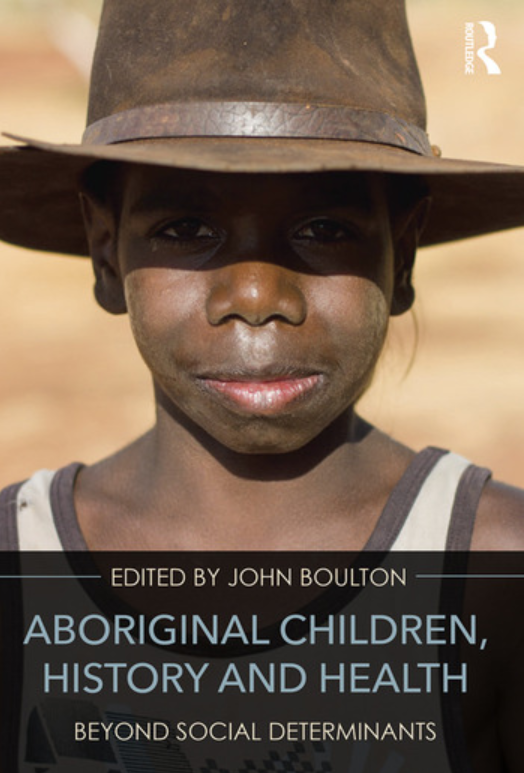
This book investigates the complex reasons for the discrepancy between the health and well-being of children in mainstream Australia and children in remote Indigenous communities. The high rate and causes of ill-health among Aboriginal children are explored through a unique blend of historical, anthropological, biological and medical analyses. Aboriginal children, history and health also includes […]
Kimberley Indigenous mental health: An examination of metabolic syndrome risk factors

Objective: There is an increased risk of physical health comorbidities in people with a mental illness. This paper examines the metabolic syndrome parameters for the general population, indigenous Australians and people with a mental illness, and compares them to a sample of predominantly indigenous adults with mental health problems. Design: A longitudinal (24 month) audit […]
Study protocol for screening and diagnosis of fetal alcohol spectrum disorders (FASD) among young people sentenced to detention in Western Australia

Introduction Prenatal alcohol exposure can cause lifelong disability, including physical, cognitive and behavioural deficits, known as fetal alcohol spectrum disorders (FASD). Among individuals with FASD, engagement with justice services is common. Little is known about the prevalence of FASD among young people engaged with the Australian justice system. This study aims to establish FASD prevalence […]
Men, hearts and minds: developing and piloting culturally specific psychometric tools assessing psychosocial stress and depression in central Australian Aboriginal men

Purpose The health inequalities experienced by Aboriginal and Torres Strait Islander Australians are well documented but there are few empirical data outlining the burden, consequences, experience and expression of depressive illness. This paper seeks to address the lack of accessible, culturally specific measures of psychosocial stress, depression or quality of life developed for, and validated […]
Increasing Indigenous self-harm and suicide in the Kimberley: an audit of the 2005–2014 data

Suicide rates among Indigenous people in the Kimberley region of Western Australia are among the highest in the world. During the period 2001–2010, age-adjusted suicide rates among Indigenous and non-Indigenous Australians were respectively 21.4 and 10.3 per 100 000 population per year. As staff of the regional state government-funded mental health service provider, Kimberley Mental […]
A Radical Activist’s Manifesto for Indigenous Australian Mental Health: Rob Riley’s legacy twenty years on
In 1995, Indigenous leader and activist Rob Riley became the first Aboriginal person to deliver a keynote address at the Australian Psychological Society (APS) annual conference. He presented a manifesto for change not only for the practice of psychology but for society as a whole. Calling for recognition of Aboriginal and Torres Strait Islanders to […]
High school outreach in remote northwest Queensland

The QIMR Berghofer’s Science and Young Minds project aimed to inspire the scientists and medical professionals of tomorrow by relaying the importance of medical research and health-related professions in an integrated school education and capacity building program. Focussing on skin health, the project included the development and delivery of science workshops to senior high school […]
What are the Frontier Wars?

The Frontier Wars refer to conflicts between Europeans and Aboriginal people including battles, acts of resistance and open massacres from 1788 to the 1930s. This website provides an overview of Aboriginal resistance to European colonisation and details a number of specific conflicts across the country. The site includes video discussion with Aboriginal and non-Indigenous peoples […]
Aboriginal and Torres Strait Islander people with a mental health condition
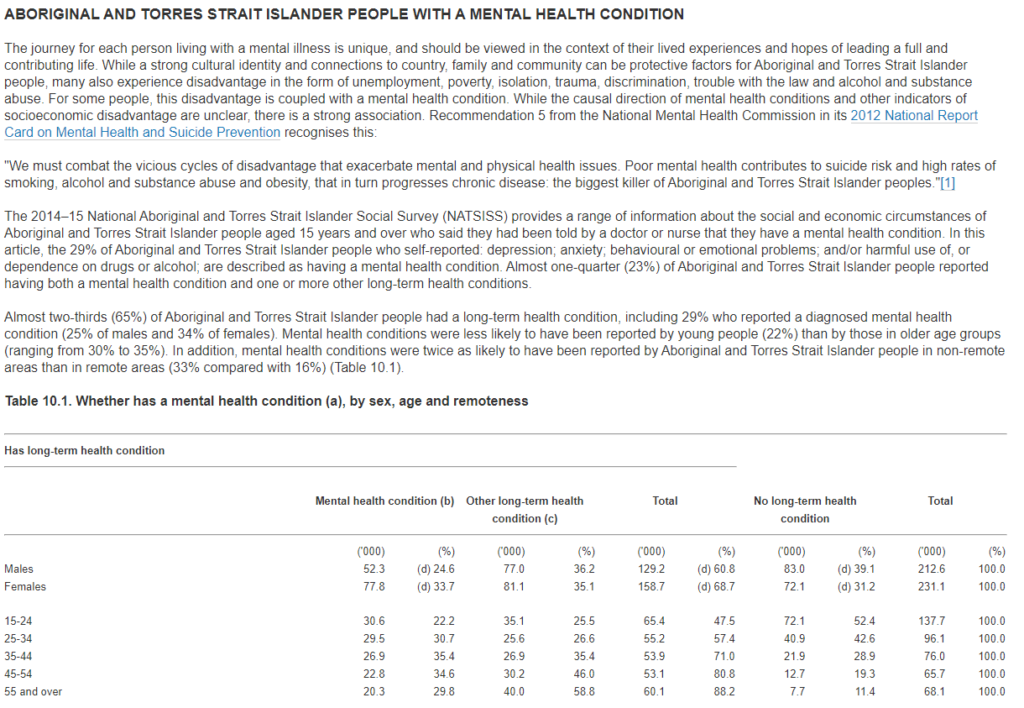
The 2014–15 National Aboriginal and Torres Strait Islander Social Survey (NATSISS) provides a range of information about the social and economic circumstances of Aboriginal and Torres Strait Islander people aged 15 years and over who said they had been told by a doctor or nurse that they have a mental health condition. In this article, […]
Lost in the great desert, preventing Aboriginal suicide

“We are working at a pace to make a real difference but in the end it will come down to governments recognising that Aboriginal and Torres Strait Islander suicide is a catastrophic humanitarian crisis. If you are an Aboriginal and Torres Strait Islander aged 15 to 35, nearly one in three deaths will be a […]
Health services explore new technology to overcome language barriers in Indigenous healthcare

With a life expectancy gap of about 10 years and poor health outcomes, some health services are looking towards new forms of technology to bridge the gap between Indigenous and non-Indigenous health services in Australia.
Racial Bias in Health Care and Health: Challenges and Opportunities

This Viewpoint describes the contribution of racial bias to disparities in health care and discusses the need to increase awareness of disparities and work toward eliminating discrimination and its adverse effects. A landmark report from the Institute of Medicine (IOM) in 2003 documented that from the simplest to the most technologically advanced diagnostic and therapeutic […]
What constitutes benefit from health care interventions for Indigenous Australians?

The health of Indigenous Australians is poor compared to that of their counterpart Australians. Further, their health is worse by international standards. The Australian Government recently made a commitment to improving the health status of Indigenous Australians through the ‘closing the health gap’ initiative. Achieving this requires an improvement in the priority setting process through […]
Aboriginal and Torres Strait Islander Health Performance Framework 2014 Report

This is the fifth report against the Aboriginal and Torres Strait Islander Health Performance Framework (HPF). The HPF monitors progress in Aboriginal and Torres Strait Islander health outcomes, health system performance and the broader determinants of health. The health of Aboriginal and Torres Strait Islander peoples is improving for a number of measures, although there […]
Developing a best practice pathway to support improvements in Indigenous Australians’ mental health and well-being: a qualitative study

Objective There is a need to adapt pathways to care to promote access to mental health services for Indigenous people in Australia. This study explored Indigenous community and service provider perspectives of well-being and ways to promote access to care for Indigenous people at risk of depressive illness. Design A participatory action research framework was […]
Assessing the social and emotional well-being of Indigenous students
Indigenous people are a vulnerable and disadvantaged population whom collectively face much higher levels of health risks and challenges than non-Indigenous people. Indigenous youth in particular represent a population that are at even greater risk, as interaction between socio-economic, geographic, and cultural differences contributes to a lack of opportunity for youth to experience positive outcomes […]
Like drawing into sand’: acceptability, feasibility, and appropriateness of a new e-mental health resource for service providers working with Aboriginal and Torres Strait Islander people

Cross-cultural considerations and difficulties recruiting and retaining skilled workers in rural and remote regions may contribute to poorer service use for Aboriginal and Torres Strait Islander people. However, electronic resources may provide the opportunity for remote workforces to deliver structured, evidence-based, culturally appropriate treatments with limited training burden. The aim was to develop and determine […]
Traditional Aboriginal Healing & Western Medicine, The Missing Gap
The sixth Slice of LIME Seminar was hosted by the Poche Indigenous Health Network in Sydney, on Thursday 28th April 2016. Do we need traditional Aboriginal medicine working with western medicine to close the gap? This Close the Gap forum considered the health maintenance and traditional healing practices of Aboriginal Ngangkari in western medicine. Could […]
A tertiary approach to improving equity in health: quantitative analysis of the Māori and Pacific Admission Scheme (MAPAS) process, 2008–2012

Introduction Achieving health equity for indigenous and ethnic minority populations requires the development of an ethnically diverse health workforce. This study explores a tertiary admission programme targeting Māori and Pacific applicants to nursing, pharmacy and health sciences (a precursor to medicine) at the University of Auckland (UoA), Aotearoa New Zealand (NZ). Application of cognitive and […]
Aboriginal communities improving Aboriginal health: An evidence review on the contribution of Aboriginal Community Controlled Health Services to improving Aboriginal health

Aboriginal communities have a long history of working to address the needs of Aboriginal peoples. Since the first Aboriginal Community Controlled Health Service (ACCHS) was established in Redfern, NSW in 1971, more than 150 ACCHSs have been established around Australia. While the Aboriginal community controlled health sector has long argued that ACCHSs are a vital […]
The value of partnerships: lessons from a multi-site evaluation of a national social and emotional wellbeing program for Indigenous youth

Objective: To evaluate the first three years of a national program to improve the social and emotional wellbeing of Indigenous youth in remote and regional Australia. Methods: Combination of open inquiry and audit review involving investigation of process and outcomes, with a broad national overview supplemented by five in-depth case studies in diverse settings. Results: […]
Yarning about parenthood and your bub

This booklet for Aboriginal and Torres Strait Islander audiences aims to help support the mental health of new parents. It is adapted from the What Were We Thinking program and provides practical approaches to adjusting to the new role of being a parent.
Gayaa Dhuwi (Proud Spirit) Declaration: National Aboriginal and Torres Strait Islander Leadership in Mental Health

The Wharerātā Group of Indigenous mental health leaders from Canada, the United States, Australia, Samoa and New Zealand developed the Wharerātā Declaration in 2010.1 It comprises five themes on the importance of Indigenous leadership in addressing the common mental health challenges faced by Indigenous peoples around the world. Member countries of the International Initiative for […]