
What are the Frontier Wars?

The Frontier Wars refer to conflicts between Europeans and Aboriginal people including battles, acts of resistance and open massacres from 1788 to the 1930s. This website provides an overview of Aboriginal resistance to European colonisation and details a number of specific conflicts across the country. The site includes video discussion with Aboriginal and non-Indigenous peoples […]
Aboriginal and Torres Strait Islander people with a mental health condition
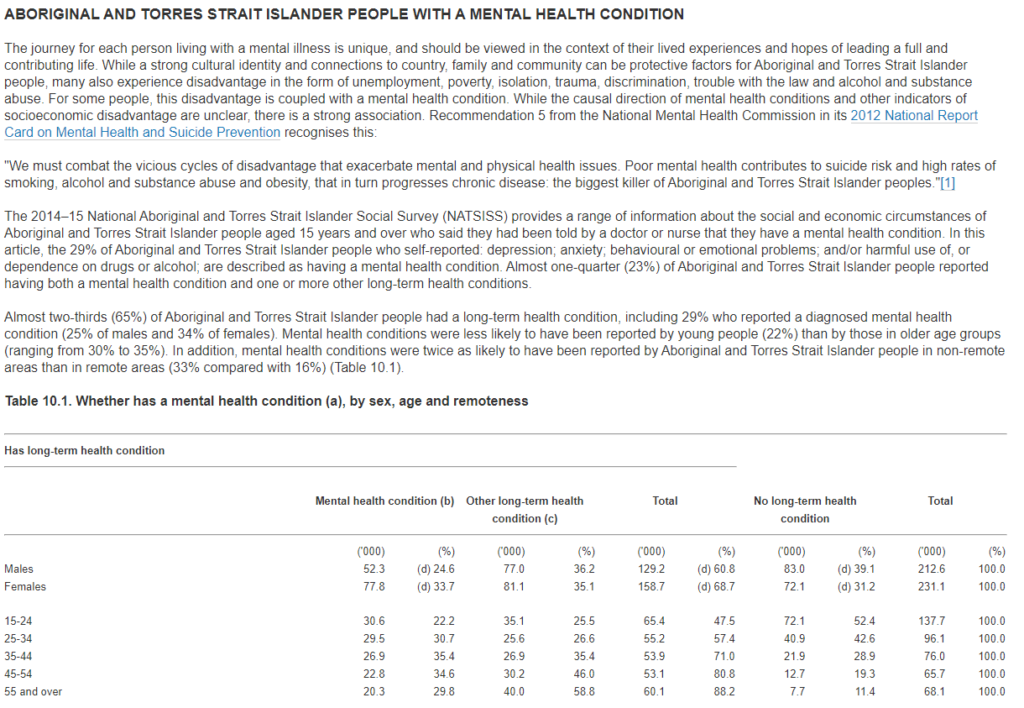
The 2014–15 National Aboriginal and Torres Strait Islander Social Survey (NATSISS) provides a range of information about the social and economic circumstances of Aboriginal and Torres Strait Islander people aged 15 years and over who said they had been told by a doctor or nurse that they have a mental health condition. In this article, […]
Illawarra Aboriginal community profile: a snapshot of an urban Aboriginal community

This community profile report provides information about the Aboriginal population of the Illawarra Region. It is intended to begin a discussion about how research can contribute to the social health and wellbeing of Aboriginal people. The report highlights disparities between Indigenous and non-Indigenous Australians that are apparent not only in the health statistics but also […]
Aboriginal and Torres Strait Islander health organisations: Online Services Report—key results 2014–15

This seventh national report presents information from 278 organisations across Australia, funded by the Australian Government to provide one or more of the following health services to Aboriginal and Torres Strait Islander people: primary health care, maternal and child health care, social and emotional wellbeing services, and substance-use services. These organisations participated in the 2014–15 […]
The Study of Environment on Aboriginal Resilience and Child Health (SEARCH): a long-term platform for closing the gap

The full potential for research to improve Aboriginal health has not yet been realised. This paper describes an established long-term action partnership between Aboriginal Community Controlled Health Services (ACCHSs), the Aboriginal Health and Medical Research Council of New South Wales (AH&MRC), researchers and the Sax Institute, which is committed to using high-quality data to bring […]
Cultural experiences of student and new-graduate dietitians in the Gomeroi gaaynggal ArtsHealth program: a quality assurance project

Issue addressed: Undergraduate dietetic students are required to demonstrate cultural awareness and culturally respectful communication to meet national competencies, but exposure to practical experiences may be limited. The Gomeroi gaaynggal ArtsHealth Centre was established in 2009 after community consultation with the Indigenous community in Tamworth, New South Wales. The Centre provides a safe and welcoming […]
Improving healthcare for Aboriginal Australians through effective engagement between community and health services
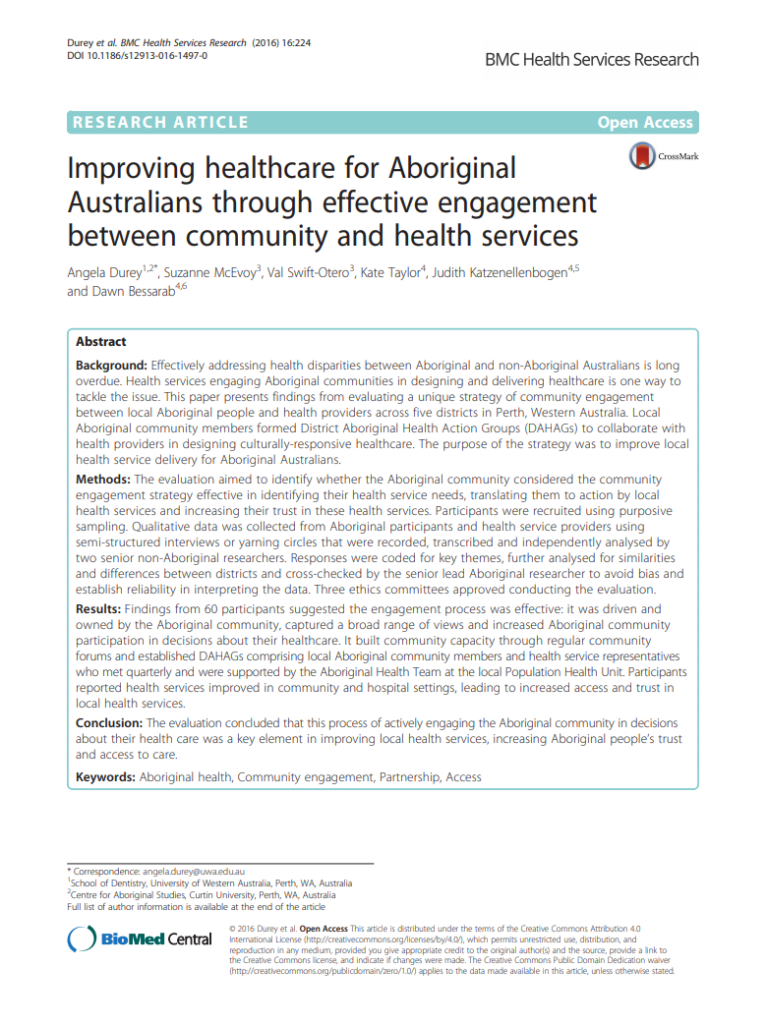
Background Effectively addressing health disparities between Aboriginal and non-Aboriginal Australians is long overdue. Health services engaging Aboriginal communities in designing and delivering healthcare is one way to tackle the issue. This paper presents findings from evaluating a unique strategy of community engagement between local Aboriginal people and health providers across five districts in Perth, Western […]
Who Cares and does it matter for the labour market? A longitudinal analysis of the labour force status of Indigenous and non-Indigenous carers

Indigenous Australians experience higher rates of severe or profound disability than other Australians, and the gap in rates of disability between Indigenous and non-Indigenous Australians increases with age. The relatively high rates of disability among the Indigenous population corresponds with heavy caring burdens. It has been well established that carers of a person with a […]
Back to the Future: Traditional knowledge healing learning journeys

The theme of this paper is embracing traditional knowledge in innovative educational change to move back to the future while stepping into action. A pertinent theme given many Indigenous health professionals have been leading action in our nation for many years in providing holistic healing opportunities for Indigenous communities. However, there is still much to […]
Colonisation, racism and Indigenous health

In settler-colonies such as Canada, Australia, New Zealand and the United States, the historical impacts of colonisation on the health, social, economic and cultural experiences of Indigenous peoples are well documented. However, despite being a commonly deployed trope, there has been scant attention paid to precisely how colonial processes contribute to contemporary disparities in health […]
Study of Environment on Aboriginal Resilience and Child Health

SEARCH, the Study of Environment on Aboriginal Resilience and Child Health, is Australia’s largest long-term study of the health and wellbeing of urban Aboriginal Children. An estimated 60% of the health gap between Aboriginal and non-Aboriginal people in Australia is attributable to the health of people living in non-remote, urban areas. While 57% of the […]
Indigenous and tribal peoples’ health (The Lancet-Lowitja Institute Global Collaboration): a population study

Background: International studies of the health of Indigenous and tribal peoples provide important public health insights. Reliable data are required for the development of policy and health services. Previous studies document poorer outcomes for Indigenous peoples compared with benchmark populations, but have been restricted in their coverage of countries or the range of health indicators. […]
Achieving stability for Aboriginal and Torres Strait Islander children in out-of-home care – SNAICC Policy Position Statement

SNAICC and many of its members have been watching with concern as, around the country, a range of processes are undertaken to progress longer-term care arrangements for children. They vary in detail but have been broadly described as permanency planning measures. Some of these proposals have already taken the form of legislative changes (NSW, Vic. […]
A 10-year-old girl kills herself, and a nation asks: what can be done?

Last week’s terrible news that a 10-year-old Aboriginal girl had taken her own life shook many Australians. Yet there would be few Aboriginal families who have not already been affected by the suicide or attempted suicide of their young people. This includes our own extended families and kin.
Traditional Aboriginal Healing & Western Medicine, The Missing Gap
The sixth Slice of LIME Seminar was hosted by the Poche Indigenous Health Network in Sydney, on Thursday 28th April 2016. Do we need traditional Aboriginal medicine working with western medicine to close the gap? This Close the Gap forum considered the health maintenance and traditional healing practices of Aboriginal Ngangkari in western medicine. Could […]
A tertiary approach to improving equity in health: quantitative analysis of the Māori and Pacific Admission Scheme (MAPAS) process, 2008–2012

Introduction Achieving health equity for indigenous and ethnic minority populations requires the development of an ethnically diverse health workforce. This study explores a tertiary admission programme targeting Māori and Pacific applicants to nursing, pharmacy and health sciences (a precursor to medicine) at the University of Auckland (UoA), Aotearoa New Zealand (NZ). Application of cognitive and […]
Aboriginal communities improving Aboriginal health: An evidence review on the contribution of Aboriginal Community Controlled Health Services to improving Aboriginal health

Aboriginal communities have a long history of working to address the needs of Aboriginal peoples. Since the first Aboriginal Community Controlled Health Service (ACCHS) was established in Redfern, NSW in 1971, more than 150 ACCHSs have been established around Australia. While the Aboriginal community controlled health sector has long argued that ACCHSs are a vital […]
The value of partnerships: lessons from a multi-site evaluation of a national social and emotional wellbeing program for Indigenous youth

Objective: To evaluate the first three years of a national program to improve the social and emotional wellbeing of Indigenous youth in remote and regional Australia. Methods: Combination of open inquiry and audit review involving investigation of process and outcomes, with a broad national overview supplemented by five in-depth case studies in diverse settings. Results: […]
Yarning about parenthood and your bub

This booklet for Aboriginal and Torres Strait Islander audiences aims to help support the mental health of new parents. It is adapted from the What Were We Thinking program and provides practical approaches to adjusting to the new role of being a parent.
Gayaa Dhuwi (Proud Spirit) Declaration: National Aboriginal and Torres Strait Islander Leadership in Mental Health

The Wharerātā Group of Indigenous mental health leaders from Canada, the United States, Australia, Samoa and New Zealand developed the Wharerātā Declaration in 2010.1 It comprises five themes on the importance of Indigenous leadership in addressing the common mental health challenges faced by Indigenous peoples around the world. Member countries of the International Initiative for […]
Development and validation of the Australian Aboriginal racial identity and self-esteem survey for 8–12 year old children (IRISE_C)

Introduction: In Australia, there is little empirical research of the racial identity of Indigenous children and youth as the majority of the current literature focuses on adults. Furthermore, there are no instruments developed with cultural appropriateness when exploring the identity and self-esteem of the Australian Aboriginal population, especially children. The IRISE_C (Racial Identity and Self-Esteem […]
Arnhem Land community-driven mental health program being used as case study for rest of country

A community-driven mental health program in an Arnhem Land Indigenous community is being held up as a case study for the rest of Australia. A small local team has been running the program at Galiwin’ku on Elcho Island for the past eight years, which has included support for the community in the aftermath of two […]
Aboriginal Children and Young People Speak Out

Since 2007, Aboriginal children and young people have participated in a range of the Commissioner’s consultation projects on topics such as wellbeing, mental health and alcohol-related harm. Additionally, the Commissioner has consulted with Aboriginal children and young people, their families and communities, during many visits to regional and remote communities from Kununurra to Albany and […]
Cultural Responsiveness in Action – An IAHA Framework

The IAHA Cultural Responsiveness Framework provides information and support to prepare you to engage in a transformation so that, whatever your role, you can positively influence the health and wellbeing, quality of life, future aspirations, and prosperity of Aboriginal and Torres Strait Islander individuals, families and communities.
Rising Spirits Community Resilience Project – Final Research Report

The Rising Spirits Project investigated what supports Aboriginal people need during bereavement, what is available that is being utilised by Aboriginal people, where the gaps are and the levels of community and state readiness to address grief and loss.