
Who Cares and does it matter for the labour market? A longitudinal analysis of the labour force status of Indigenous and non-Indigenous carers

Indigenous Australians experience higher rates of severe or profound disability than other Australians, and the gap in rates of disability between Indigenous and non-Indigenous Australians increases with age. The relatively high rates of disability among the Indigenous population corresponds with heavy caring burdens. It has been well established that carers of a person with a […]
Indigenous and tribal peoples’ health (The Lancet-Lowitja Institute Global Collaboration): a population study

Background: International studies of the health of Indigenous and tribal peoples provide important public health insights. Reliable data are required for the development of policy and health services. Previous studies document poorer outcomes for Indigenous peoples compared with benchmark populations, but have been restricted in their coverage of countries or the range of health indicators. […]
A 10-year-old girl kills herself, and a nation asks: what can be done?

Last week’s terrible news that a 10-year-old Aboriginal girl had taken her own life shook many Australians. Yet there would be few Aboriginal families who have not already been affected by the suicide or attempted suicide of their young people. This includes our own extended families and kin.
Close the Gap – Progress and priorities report 2016

This report from the Close the Gap Campaign Steering Committee provides an overview of the progress made over the life of the Closing the Gap strategy. Results are mixed, with some improvements in infant and child health, while progress on closing the life expectancy gap has been minimal. The report also looks at new insights […]
Kimberley Indigenous mental health: An examination of metabolic syndrome risk factors

Objective: There is an increased risk of physical health comorbidities in people with a mental illness. This paper examines the metabolic syndrome parameters for the general population, indigenous Australians and people with a mental illness, and compares them to a sample of predominantly indigenous adults with mental health problems. Design: A longitudinal (24 month) audit […]
Illawarra Aboriginal community profile: a snapshot of an urban Aboriginal community

This community profile report provides information about the Aboriginal population of the Illawarra Region. It is intended to begin a discussion about how research can contribute to the social health and wellbeing of Aboriginal people. The report highlights disparities between Indigenous and non-Indigenous Australians that are apparent not only in the health statistics but also […]
Review of illicit drug use among Aboriginal and Torres Strait Islander people

The purpose of this review is to provide an overview of the use of illicit drugs among Aboriginal and Torres Strait Islander people in Australia. It provides general information on the context of illicit drug use in Australia and the factors of particular relevance to Aboriginal and Torres Strait Islander people, including the historical context, […]
Calls for a royal commission into the alarming rate of Indigenous youth suicide

As many as one in ten Indigenous deaths could be caused by suicide, a suicide prevention researcher has warned. Gerry Georgatos says the official statistics are masking the true extent of the crisis, and he’s sounding the alarm on the rate of suicide amongst young Indigenous Australians. ‘Too many are dying too young,’ says Georgatos. […]
Study of Environment on Aboriginal Resilience and Child Health

SEARCH, the Study of Environment on Aboriginal Resilience and Child Health, is Australia’s largest long-term study of the health and wellbeing of urban Aboriginal Children. An estimated 60% of the health gap between Aboriginal and non-Aboriginal people in Australia is attributable to the health of people living in non-remote, urban areas. While 57% of the […]
A profile of the Aboriginal and Torres Strait Islander higher education student population

This paper brings together recent statistics relating to the participation of Aboriginal and Torres Strait Islander students in higher education. A number of key statistical realities relating to their enrolment into, retention during, and completion of, their university courses are depicted. Foremost amongst these realities is that despite the initiatives over recent years to redress […]
Australian Medical Association 2015 Report card on Indigenous Health

Implementation Plan for the National Aboriginal and Torres Strait Islander Health Plan 2013–2023

Both the Implementation Plan and the National Aboriginal and Torres Strait Islander Health Plan 2013–2023 (Health Plan) have been developed in close partnership with the National Health Leadership Forum and reflect the priorities that will improve the health and wellbeing of Aboriginal and Torres Strait Islander peoples. The Implementation Plan outlines the actions to be […]
Aboriginal and Torres Strait Islander Health Performance Framework 2014 Report

This is the fifth report against the Aboriginal and Torres Strait Islander Health Performance Framework (HPF). The HPF monitors progress in Aboriginal and Torres Strait Islander health outcomes, health system performance and the broader determinants of health. The health of Aboriginal and Torres Strait Islander peoples is improving for a number of measures, although there […]
Overview of Australian Indigenous health status 2014

This Overview of Australian Indigenous health status provides a comprehensive summary of the most recent indicators of the health of Aboriginal and Torres Strait Islander people in Australia (states and territories are: New South Wales (NSW), Victoria (Vic), Queensland (Qld), Western Australia (WA), South Australia (SA), Tasmania (Tas), The Australian Capital Territory (ACT) and The […]
Rising Spirits Community Resilience Project – Final Research Report

The Rising Spirits Project investigated what supports Aboriginal people need during bereavement, what is available that is being utilised by Aboriginal people, where the gaps are and the levels of community and state readiness to address grief and loss.
Social Justice and Native Title Report 2015
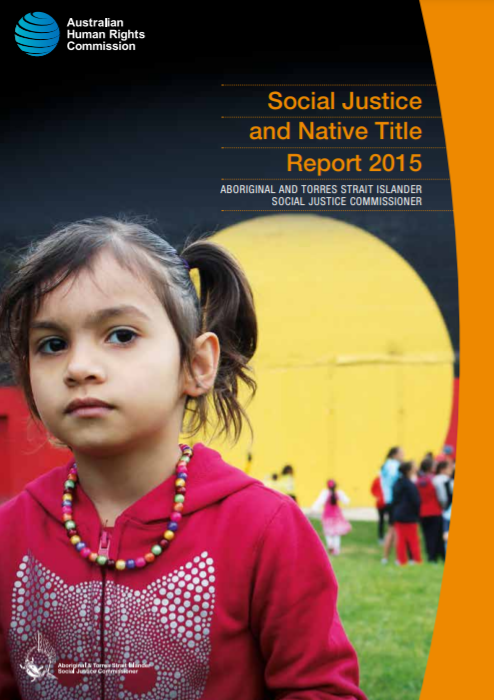
The Social Justice and Native Title Report from the Aboriginal and Torres Strait Islander Social Justice Commissioner is delivered to the Australian Parliament on the exercise and enjoyment of the human rights of Aboriginal and Torres Strait Islander peoples. This also includes reporting on the operation of the Native Title Act 1993 (Cth) and its […]
Lost in the great desert, preventing Aboriginal suicide

“We are working at a pace to make a real difference but in the end it will come down to governments recognising that Aboriginal and Torres Strait Islander suicide is a catastrophic humanitarian crisis. If you are an Aboriginal and Torres Strait Islander aged 15 to 35, nearly one in three deaths will be a […]
The Elders Report into preventing Indigenous self-harm and youth suicide

Interview excerpts of Elders featured in the Report. The Culture Is Life campaign aims to give a platform for Indigenous Elders and community leaders to influence public awareness, policy-making and service provision around Indigenous suicide prevention. One of the initial actions of the Culture Is Life campaign was the development of the’Elders Report on Preventing […]
A reference list for teaching about Indigenous Australians in psychology

The purpose of the list is to compile a reference list for psychology professionals who might be searching for relevant research to cover in their undergraduate courses. The list is partial and doubtless will expand in future updates. Sections include: 1) Scholarly articles 2) Coverage of relevant issues in psychology textbooks; 3) Psychology studies with […]
The Lowitja Institute – Literature Search

This search tool provides easy access to Aboriginal and Torres Strait Islander health literature on the PubMed database You can choose to look at all literature or one of 27 search topics. You can refine each choice by entering keywords, filter options and published dates.
Analysis & Policy Observatory – Indigenous

IRHD Publications and Resources Index

Database of publications and resources produced by and for the Indigenous and Rural Health Division
Closing the Gap Clearinghouse

A clearinghouse for research and evaluation evidence on what works to overcome Indigenous disadvantage
Bringing Them Home Oral history interviews

In December 1997, in response to the first recommendation of Bringing Them Home: Report of the National Inquiry into the Separation of Aboriginal and Torres Strait Islander Children from Their Families, the Commonwealth Government announced the National Library would be funded to develop and manage an oral history project. The Bringing Them Home Oral History […]
Footprints in time: the longitudinal study of Indigenous children

This website provides information on the Footprints in Time study and links to its publications. Footprints in Time is the name given to the Longitudinal Study of Indigenous Children (LSIC), an initiative of the Australian Government. Footprints in Time is conducted by the Department of Social Services (DSS) under the guidance of the Footprints in […]