
A 10-year-old girl kills herself, and a nation asks: what can be done?

Last week’s terrible news that a 10-year-old Aboriginal girl had taken her own life shook many Australians. Yet there would be few Aboriginal families who have not already been affected by the suicide or attempted suicide of their young people. This includes our own extended families and kin.
Gambay – Languages Map

First Languages Australia is working with regional language centres nationally to develop a map of Australian languages that reflects the names and groupings favoured by community. Regional language centres have provided updated maps for their regions to be collated into this interactive map of languages and language families. Some regions have choosen to show related […]
Healing for Our Stolen Generations: sharing our stories

This report is a review of the first two years of projects funded under the Healing Foundation’s Stolen Generations Initiative 2013-2015.
‘We’re checking them out’: Indigenous and non-Indigenous research participants’ accounts of deciding to be involved in research

Background: It is important for researchers to understand the motivations and decision-making processes of participants who take part in their research. This enables robust informed consent and promotes research that meets the needs and expectations of the community. It is particularly vital when working with Indigenous communities, where there is a history of exploitative research […]
The Stolen Generations: The forced removal of First Peoples children in Australia

This chapter considers the removal of Indigenous children as a global colonial and neocolonial tactic. The history of the Australian Stolen Generations is focused on, from the beginning of the abduction of children in the early 1900s up until 2015. The landmark 1997 Bringing Them Home: Report of the National Inquiry into the Separation of […]
Finding Common Ground – Avoiding the Terminology Trap

The fourth Slice of LIME Seminar was held on 27th April 2015, hosted by the University of Sydney. This event was a Poche Indigenous Health Network Key Thinkers Forum and a National Senior Teaching Fellowship activity, supported by the Office of Learning and Teaching. The forum focused on identifying and applying critical elements of cultural […]
Social Justice and Native Title Report 2015
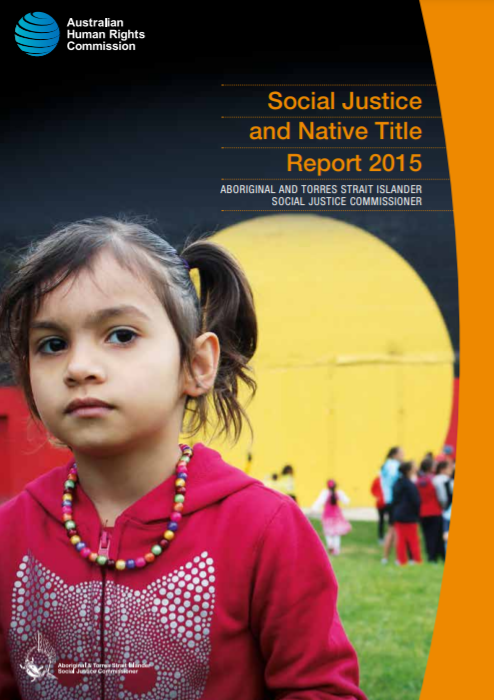
The Social Justice and Native Title Report from the Aboriginal and Torres Strait Islander Social Justice Commissioner is delivered to the Australian Parliament on the exercise and enjoyment of the human rights of Aboriginal and Torres Strait Islander peoples. This also includes reporting on the operation of the Native Title Act 1993 (Cth) and its […]
Gayaa Dhuwi (Proud Spirit) Declaration: National Aboriginal and Torres Strait Islander Leadership in Mental Health

The Wharerātā Group of Indigenous mental health leaders from Canada, the United States, Australia, Samoa and New Zealand developed the Wharerātā Declaration in 2010.1 It comprises five themes on the importance of Indigenous leadership in addressing the common mental health challenges faced by Indigenous peoples around the world. Member countries of the International Initiative for […]
Cultural Responsiveness in Action – An IAHA Framework

The IAHA Cultural Responsiveness Framework provides information and support to prepare you to engage in a transformation so that, whatever your role, you can positively influence the health and wellbeing, quality of life, future aspirations, and prosperity of Aboriginal and Torres Strait Islander individuals, families and communities.
Increasing cultural competence and Indigenous representation in psychology

Reflections on what has/has not worked for Psychology Educators. This document was developed for the Australian Indigenous Psychology Education Project (AIPEP) ‘How To’ forum held at the APS Golden Jubilee Conference, September 2015. It provides brief points on what has and has not worked for psychology educators involved in the project when attempting to implement […]
Indigenising the Psychology Curriculum – Traps and Tips

An easy to read spreadsheet listing traps, tips, and resources for psychology educators in the process of Indigensing the psychology curriculum. This document is a work in progress, all feedback and suggestions are welcomed.
Are We Asking the Right Questions? Why We Should Have a Decolonzing Discourse Based on Conscientization Rather Than Indigenizing the Curriculum

In this paper, we pose the question of terminology and definitions associated with the concept of an indigenized academy or curriculum. Calls to indigenze the academy or curriculum are implicitly asking for an overlay or inclusion of Indigenous content, preferably by Indigenous peoples, as a mechanism to incorporate histories, traditions, and knowledges that are divergent […]
Ngara…Deep Listening…Seeing ‘two ways’: What can Indigenous knowledge, mindfulness and observational skills training

The third Slice of LIME seminar was hosted by Flinders University SA on 12 September 2014. Presenters for this third Seminar include Uncle Lewis Yerloburka O’Brien (Kaurna Elder), Aunty Miriam-Rose Ungunmerr-Baumann, Prof. L.C. Chan, Dr Heather Gaunt. Rapporteur for the session was Prof Lambert Schuwirht and it was facilitated by Prof. Dennis McDermott.
Having the Hard Conversations

The second Slice of LIME Seminar was presented by Professor Dennis McDermott & Mr Dave Sjoberg from the Poche Centre for Indigenous Health and Well-Being at Flinders University South Australia, on 12th August 2014. It focused on cultural safety in health professions, & explored pedagogical methods for addressing issues such as racism, white privilege & […]
Statement of Intention to Improve Aboriginal and Torres Strait Islander Health and Wellbeing

Twenty-four national allied health organisations became signatories to the Statement of Intention to Improve Aboriginal and Torres Strait Islander Health and Wellbeing, at Parliament House in March 2014.
The Elders Report into preventing Indigenous self-harm and youth suicide

Interview excerpts of Elders featured in the Report. The Culture Is Life campaign aims to give a platform for Indigenous Elders and community leaders to influence public awareness, policy-making and service provision around Indigenous suicide prevention. One of the initial actions of the Culture Is Life campaign was the development of the’Elders Report on Preventing […]
Critical psychology in a context of ongoing acts of colonisation

Although encompassing a broad range of topic areas, approaches to analysis, and theoretical frameworks, it is arguably the case that critical psychology in Australia is best represented by research undertaken on the topic of racism. The primary reason why critical research on racism has been so prevalent in Australia, is because of the ongoing history […]
A reference list for teaching about Indigenous Australians in psychology

The purpose of the list is to compile a reference list for psychology professionals who might be searching for relevant research to cover in their undergraduate courses. The list is partial and doubtless will expand in future updates. Sections include: 1) Scholarly articles 2) Coverage of relevant issues in psychology textbooks; 3) Psychology studies with […]
No time like the present: Determinants of intentions to engage In bystander anti-racism on behalf of indigenous Australians

Do indigenous health curricula in health science education reduce disparities in health care outcomes?

Hidden obstacles to reconciliation in Australia: the persistence of stereotypes

The reconciliation movement in Australia aims to build mutually respectful relationships between indigenous and other Australians by eliminating ‘gaps’ in health and well-being, educating about Indigenous history and culture and addressing social disadvantages based on false beliefs and stereotypes. Psychological literature has much to offer to the last aim, with a wealth of research documenting […]
The contact caveat: negative contact predicts increased prejudice more than positive contact predicts reduced prejudice

Contact researchers have largely overlooked the potential for negative intergroup contact to increase prejudice. In Study 1, we tested the interaction between contact quantity and valence on prejudice toward Black Australians (n = 1,476), Muslim Australians (n = 173), and asylum seekers (n = 293). In all cases, the association between contact quantity and prejudice […]
The effects of a common in-group prime on intentions to help Indigenous and homeless Australians

The article reports on research designed to test Australian attitudes towards helping impoverished members of the Australian society, in particular, indigenous and homeless people. Australian university students completed a questionnaire to measure their attitudes towards helping homeless and indigenous people under conditions that primed a common Australian identity. The findings showed that priming an inclusive […]
A framework for decolonization intervention: broadening the focus for improving the health and wellbeing of Indigenous communities

Colonization has spread around the world and inexorably affected millions of people over the last few centuries. There have been many scattered intervention strategies to overcome some of the long-term effects of colonization, especially for health, education, and employment. With respect to the inequalities and discriminations that have remained after centuries, however, it is less […]
Atoning for Colonial Injustices: Group-Based Shame and Guilt Motivate Support for Reparation

An investigation of the role of group-based shame and guilt in motivating citizens of ex-colonial countries to support restitution to former colonized groups which were the target of violence and oppression. Study 1 (N = 125) was conducted in Australia during the lead-up to the first official government apology to Aboriginal Australians. Among white Australians, […]