
The aftermath of Aboriginal suicide: Lived experience as the missing foundation for suicide prevention and postvention

This paper aimed to highlight the systemic and theoretical barriers for Aboriginal and Torres Strait Islander people who have been bereaved by suicide. Incorporating the lived experiences of two advocates, Leilani Darwin and Julie Turner, and professional experiences of Matthew Trindall and Laura Ross, the paper explores the importance of including Aboriginal lived experiences in […]
The Australian Psychological Society’s Apology to Aboriginal and Torres Strait Islander People

The gap between Aboriginal and Torres Strait Islander and non‐Indigenous health, education, mental health, and social and emotional wellbeing remains a major concern. Bridging these gaps and working in culturally safe and responsive ways with people of Aboriginal and Torres Strait Islander descent presents considerable challenges, including for the discipline and profession of psychology. At […]
An Evaluation of the National Empowerment Project Cultural, Social, and Emotional Wellbeing Program

An array of cumulative risk and stress factors, and social inequities, have contributed to high suicides and family and community dysfunction, in two communities in Queensland. An independent, post-program evaluation of the National Empowerment Project (NEP) Cultural, Social and Emotional Wellbeing (CSEWB) Program specifically developed to address these issues was conducted in Kuranda and Cherbourg […]
What the people said: Findings from the regional Roundtables of the Aboriginal and Torres Strait Islander Suicide Prevention Evaluation Project

This paper summarises key findings from the six community regional Roundtables that were undertaken as part of the Australian Aboriginal and Torres Strait Islander Suicide Prevention Evaluation Project. The six community regional Roundtables were held in different locations across the country. Common themes emerging included the need for self-determination and local leadership, the need to […]
Indigenous Healing Practices in Australia. Women & Therapy

Indigenous Australian women are among the most disadvantaged women in the world. Over two centuries of colonization have had a damaging impact on perceptions of their gender roles and status as well as many other consequential oppressions. These experiences have affected the social and emotional wellbeing of Indigenous women of all ages, resulting in socio-economic […]
Decolonising Psychology: Validating Social and Emotional Wellbeing: Social and Emotional Wellbeing

Objective Australian Aboriginal and Torres Strait Islander social and emotional wellbeing (SEWB) is a multifaceted concept that acknowledges that a person’s wellbeing is determined by a range of inter-related domains: body, mind and emotions, family and kinship, community, culture, Country, and spirituality. This paper explores the meaning of these seven domains of SEWB. Method A […]
Housing and Overcrowding in Remote Indigenous Communities: Impacts and Solutions from a Holistic Perspective

Over three years, a $12 million Commonwealth funded consortium project implemented energy efficiency initiatives in six remote Indigenous communities. An ecological community-based participatory action research design that utilized qualitative and quantitative research approaches in a multiple methods design was employed to clarify how Yolŋu use power, to identify the barriers and enablers of Yolŋu using […]
Aboriginal children, history and health: beyond social determinants
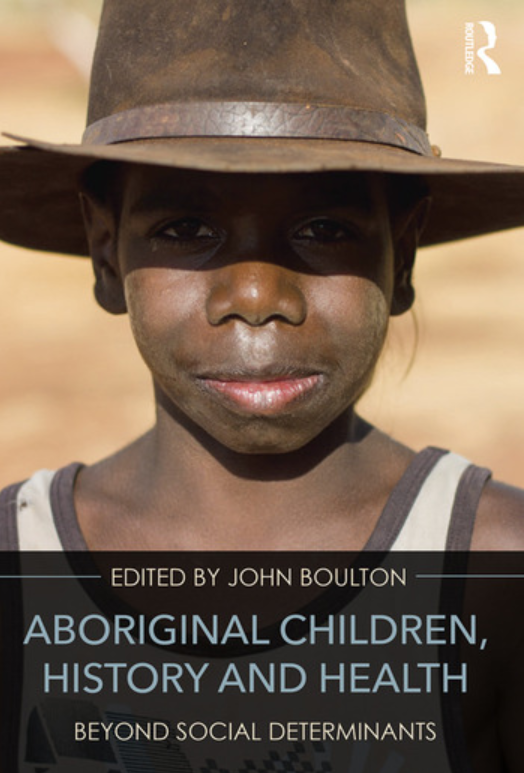
This book investigates the complex reasons for the discrepancy between the health and well-being of children in mainstream Australia and children in remote Indigenous communities. The high rate and causes of ill-health among Aboriginal children are explored through a unique blend of historical, anthropological, biological and medical analyses. Aboriginal children, history and health also includes […]
Kimberley Indigenous mental health: An examination of metabolic syndrome risk factors

Objective: There is an increased risk of physical health comorbidities in people with a mental illness. This paper examines the metabolic syndrome parameters for the general population, indigenous Australians and people with a mental illness, and compares them to a sample of predominantly indigenous adults with mental health problems. Design: A longitudinal (24 month) audit […]
Study protocol for screening and diagnosis of fetal alcohol spectrum disorders (FASD) among young people sentenced to detention in Western Australia

Introduction Prenatal alcohol exposure can cause lifelong disability, including physical, cognitive and behavioural deficits, known as fetal alcohol spectrum disorders (FASD). Among individuals with FASD, engagement with justice services is common. Little is known about the prevalence of FASD among young people engaged with the Australian justice system. This study aims to establish FASD prevalence […]
Men, hearts and minds: developing and piloting culturally specific psychometric tools assessing psychosocial stress and depression in central Australian Aboriginal men

Purpose The health inequalities experienced by Aboriginal and Torres Strait Islander Australians are well documented but there are few empirical data outlining the burden, consequences, experience and expression of depressive illness. This paper seeks to address the lack of accessible, culturally specific measures of psychosocial stress, depression or quality of life developed for, and validated […]
Increasing Indigenous self-harm and suicide in the Kimberley: an audit of the 2005–2014 data

Suicide rates among Indigenous people in the Kimberley region of Western Australia are among the highest in the world. During the period 2001–2010, age-adjusted suicide rates among Indigenous and non-Indigenous Australians were respectively 21.4 and 10.3 per 100 000 population per year. As staff of the regional state government-funded mental health service provider, Kimberley Mental […]
A Radical Activist’s Manifesto for Indigenous Australian Mental Health: Rob Riley’s legacy twenty years on
In 1995, Indigenous leader and activist Rob Riley became the first Aboriginal person to deliver a keynote address at the Australian Psychological Society (APS) annual conference. He presented a manifesto for change not only for the practice of psychology but for society as a whole. Calling for recognition of Aboriginal and Torres Strait Islanders to […]
High school outreach in remote northwest Queensland

The QIMR Berghofer’s Science and Young Minds project aimed to inspire the scientists and medical professionals of tomorrow by relaying the importance of medical research and health-related professions in an integrated school education and capacity building program. Focussing on skin health, the project included the development and delivery of science workshops to senior high school […]
What are the Frontier Wars?

The Frontier Wars refer to conflicts between Europeans and Aboriginal people including battles, acts of resistance and open massacres from 1788 to the 1930s. This website provides an overview of Aboriginal resistance to European colonisation and details a number of specific conflicts across the country. The site includes video discussion with Aboriginal and non-Indigenous peoples […]
Aboriginal and Torres Strait Islander people with a mental health condition
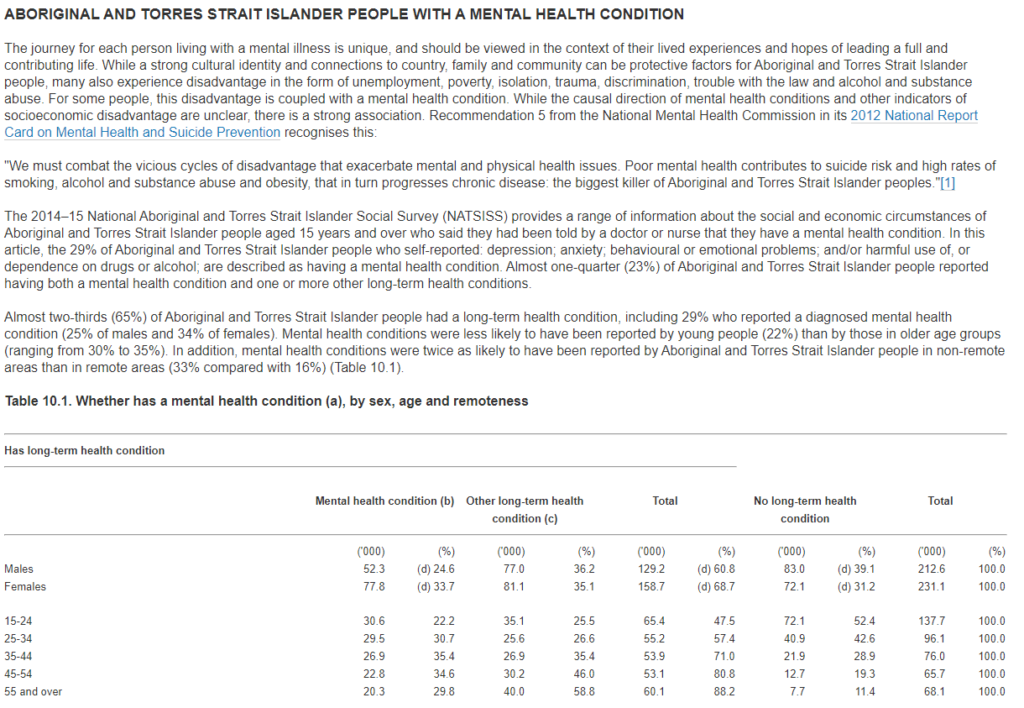
The 2014–15 National Aboriginal and Torres Strait Islander Social Survey (NATSISS) provides a range of information about the social and economic circumstances of Aboriginal and Torres Strait Islander people aged 15 years and over who said they had been told by a doctor or nurse that they have a mental health condition. In this article, […]
Illawarra Aboriginal community profile: a snapshot of an urban Aboriginal community

This community profile report provides information about the Aboriginal population of the Illawarra Region. It is intended to begin a discussion about how research can contribute to the social health and wellbeing of Aboriginal people. The report highlights disparities between Indigenous and non-Indigenous Australians that are apparent not only in the health statistics but also […]
Aboriginal and Torres Strait Islander health organisations: Online Services Report—key results 2014–15

This seventh national report presents information from 278 organisations across Australia, funded by the Australian Government to provide one or more of the following health services to Aboriginal and Torres Strait Islander people: primary health care, maternal and child health care, social and emotional wellbeing services, and substance-use services. These organisations participated in the 2014–15 […]
The Study of Environment on Aboriginal Resilience and Child Health (SEARCH): a long-term platform for closing the gap

The full potential for research to improve Aboriginal health has not yet been realised. This paper describes an established long-term action partnership between Aboriginal Community Controlled Health Services (ACCHSs), the Aboriginal Health and Medical Research Council of New South Wales (AH&MRC), researchers and the Sax Institute, which is committed to using high-quality data to bring […]
Cultural experiences of student and new-graduate dietitians in the Gomeroi gaaynggal ArtsHealth program: a quality assurance project

Issue addressed: Undergraduate dietetic students are required to demonstrate cultural awareness and culturally respectful communication to meet national competencies, but exposure to practical experiences may be limited. The Gomeroi gaaynggal ArtsHealth Centre was established in 2009 after community consultation with the Indigenous community in Tamworth, New South Wales. The Centre provides a safe and welcoming […]
Improving healthcare for Aboriginal Australians through effective engagement between community and health services
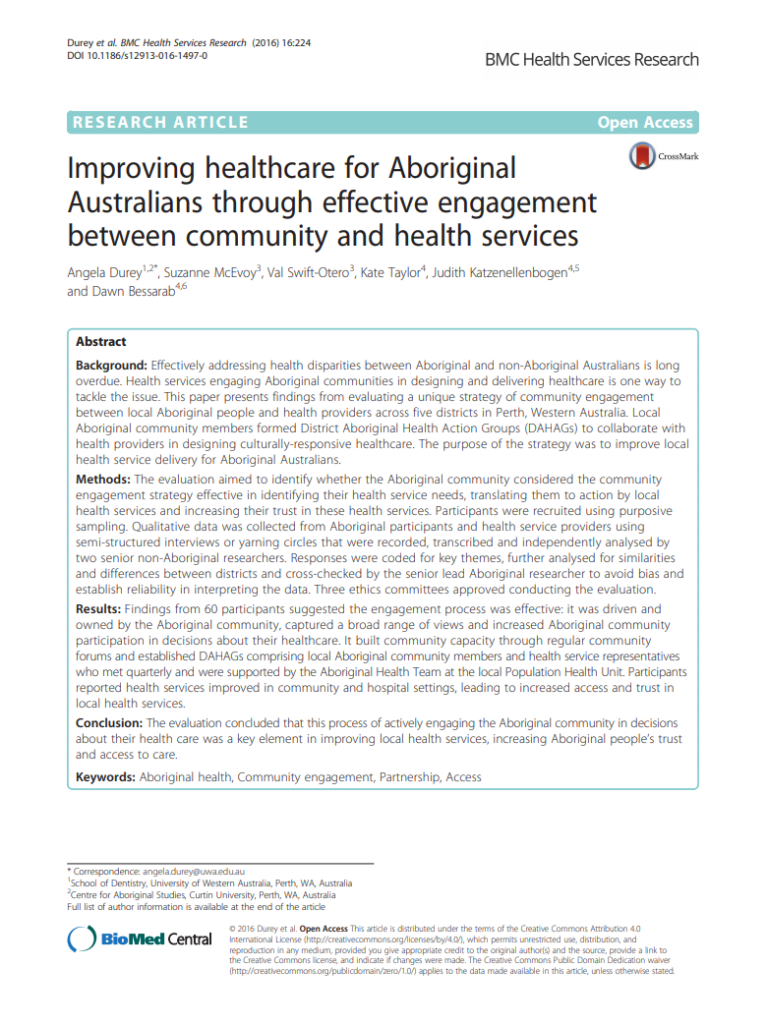
Background Effectively addressing health disparities between Aboriginal and non-Aboriginal Australians is long overdue. Health services engaging Aboriginal communities in designing and delivering healthcare is one way to tackle the issue. This paper presents findings from evaluating a unique strategy of community engagement between local Aboriginal people and health providers across five districts in Perth, Western […]
Who Cares and does it matter for the labour market? A longitudinal analysis of the labour force status of Indigenous and non-Indigenous carers

Indigenous Australians experience higher rates of severe or profound disability than other Australians, and the gap in rates of disability between Indigenous and non-Indigenous Australians increases with age. The relatively high rates of disability among the Indigenous population corresponds with heavy caring burdens. It has been well established that carers of a person with a […]
Back to the Future: Traditional knowledge healing learning journeys

The theme of this paper is embracing traditional knowledge in innovative educational change to move back to the future while stepping into action. A pertinent theme given many Indigenous health professionals have been leading action in our nation for many years in providing holistic healing opportunities for Indigenous communities. However, there is still much to […]
Colonisation, racism and Indigenous health

In settler-colonies such as Canada, Australia, New Zealand and the United States, the historical impacts of colonisation on the health, social, economic and cultural experiences of Indigenous peoples are well documented. However, despite being a commonly deployed trope, there has been scant attention paid to precisely how colonial processes contribute to contemporary disparities in health […]
Study of Environment on Aboriginal Resilience and Child Health

SEARCH, the Study of Environment on Aboriginal Resilience and Child Health, is Australia’s largest long-term study of the health and wellbeing of urban Aboriginal Children. An estimated 60% of the health gap between Aboriginal and non-Aboriginal people in Australia is attributable to the health of people living in non-remote, urban areas. While 57% of the […]