
Whole of community suicide prevention forums for Aboriginal Australians

It is well known that Aboriginal Australians are at increased risk of suicide. Contributors to suicide differ for Indigenous and non-Indigenous populations (Westerman, 2003; 2019). This study evaluated whole of community suicide prevention forums conducted across six locations. Attendees were youth (N = 136), service providers (N = 225), and community members (N = 158). The content of […]
Developing cultural responsiveness

How do higher education providers introduce an understanding of cultural responsiveness to psychology students? We’re joined by three academics from the University of Western Australia to discuss the issues. Professor Pat Dudgeon is Australia’s first identified Indigenous psychologist. Dr Joanna Alexi is a research associate. And Professor Romola Bucks is Pro Vice-Chancellor (Health and Medical […]
Australia needs to decolonise its mental health system and empower more Indigenous psychologists
Solutions that Work: What the Evidence of our People Tell Us: Aboriginal and Torres Strait Islander Suicide Prevention Evaluation Report.

Building Indigenous health workforce capacity and capability through leadership – the Miwatj health leadership model

Aim: In the crowded field of leadership research, Indigenous leadership remains under-researched. This article explores the Leadership Model of an Aboriginal Community Controlled Primary Health Care Organisation providing services to the Yolngu people of remote northern Australia: the Miwatj Health Aboriginal Corporation (Miwatj). Background: The limited research which does exist on Indigenous leadership points to […]
Collaborative practices and partnerships to engage with Aboriginal and Torres Strait Islander students

Griffith University has one of the largest cohorts of Indigenous students, with 815 enrolments to date. The Bachelor of Psychology (Honours) and Bachelor of Psychological Science programs attract a high number of students from around the country each year. Of the 295 students enrolled in health-related degrees, 70 Aboriginal and/or Torres Strait Islander students are […]
Australia needs to decolonise its mental health system and empower more Indigenous psychologists

Decolonising psychology and the transformative role of the AIPEP

Indigenous Knowledge and Mental Health

This text represents a wholly refreshing, important, challenging, and creative contribution to the literature addressing the impacts of colonization on the well-being of Indigenous Peoples and the role of Indigenous knowledge(s) in healing and wellbeing.
The Role of Psychologists in a Changing Time

This is the third video in a three-part video series and collaboration between the Transforming Indigenous Mental Health and Wellbeing project and Pearson Australia. This dynamic three-part video series provides foundational learning about Aboriginal and Torres Strait Islander cultural knowledges, and explores contemporary global issues, such as the Black Lives Matter movement. Together, the video […]
Kaartajin Ngundabut Indigenous Cultural Knowledge

This is the second video in a three-part video series and collaboration between the Transforming Indigenous Mental Health and Wellbeing project and Pearson Australia. This dynamic three-part video series provides foundational learning about Aboriginal and Torres Strait Islander cultural knowledges, and explores contemporary global issues, such as the Black Lives Matter movement. Together, the video […]
Introduction to Indigenous Psychology

This is the first video in a three-part video series and collaboration between the Transforming Indigenous Mental Health and Wellbeing project and Pearson Australia. This dynamic three-part video series provides foundational learning about Aboriginal and Torres Strait Islander cultural knowledges, and explores contemporary global issues, such as the Black Lives Matter movement. Together, the video […]
Self-determination and strengths-based Aboriginal and Torres Strait Islander suicide prevention: An emerging evidence-based approach

This chapter explores the emerging international evidence-base within Indigenous suicide research which supports holistic, strengths-based, culturally safe prevention and focuses on the importance of self-determination and cultural-continuity within communities. The social and cultural determinants of Aboriginal and Torres Strait Islander suicide are discussed along with culturally specific understandings of living well, or social and emotional […]
Addressing inequities in Indigenous mental health and wellbeing through transformative and decolonising research and practice

Aim: This paper discusses the current mental health and social and emotional wellbeing in Indigenous Australian mental health and wellbeing, the gaps in research, the need for transformative and decolonising research and practice, and the opportunities and recommendations to address existing mental health inequities. Method: This paper reviews key mental health and social and wellbeing […]
Aboriginal Participatory Action Research: An Indigenous Research Methodology Strengthening Decolonisation and Social and Emotional Wellbeing

This discussion paper explicates the concepts and application of a critically reflexive and transformative Indigenous Research Methodology (IRM) — Aboriginal Participatory Action Research (APAR) — designed to centre and increase Indigenous voice and ‘epistemic self-determination’ in Indigenous research and psychology. The intent is to justify and legitimate Indigenous knowledges and methodologies as authentic, rightful, valued, […]
Contributions to urban Indigenous self-determination: The story of Neeginan and Kaupapa Māori
This paper considers two different Indigenous-led initiatives, the Neeginan initiative (Winnipeg, Canada) and the Kaupapa Māori movement (New Zealand), within the context of urban Indigenous self-determination, examining the role, or contributions of, each towards the realisation of Indigenous self-determination. Neeginan originates from, and focuses on, building a sense of community, through education programs, social assistance […]
Wellbeing and Healing Through Connection and Culture

This review summarises the emerging research and knowledge, key themes and principles surrounding Aboriginal and Torres Strait Islander cultural perspectives and concepts of healing and social and emotional wellbeing as they relate to suicide prevention. These discussions will support Lifeline to enhance and refine their existing knowledge and practices to promote culturally responsive suicide prevention […]
The aftermath of Aboriginal suicide: Lived experience as the missing foundation for suicide prevention and postvention

This paper aimed to highlight the systemic and theoretical barriers for Aboriginal and Torres Strait Islander people who have been bereaved by suicide. Incorporating the lived experiences of two advocates, Leilani Darwin and Julie Turner, and professional experiences of Matthew Trindall and Laura Ross, the paper explores the importance of including Aboriginal lived experiences in […]
Decolonising Psychology: Validating Social and Emotional Wellbeing: Social and Emotional Wellbeing

Objective Australian Aboriginal and Torres Strait Islander social and emotional wellbeing (SEWB) is a multifaceted concept that acknowledges that a person’s wellbeing is determined by a range of inter-related domains: body, mind and emotions, family and kinship, community, culture, Country, and spirituality. This paper explores the meaning of these seven domains of SEWB. Method A […]
An Evaluation of the National Empowerment Project Cultural, Social, and Emotional Wellbeing Program

An array of cumulative risk and stress factors, and social inequities, have contributed to high suicides and family and community dysfunction, in two communities in Queensland. An independent, post-program evaluation of the National Empowerment Project (NEP) Cultural, Social and Emotional Wellbeing (CSEWB) Program specifically developed to address these issues was conducted in Kuranda and Cherbourg […]
What the people said: Findings from the regional Roundtables of the Aboriginal and Torres Strait Islander Suicide Prevention Evaluation Project

This paper summarises key findings from the six community regional Roundtables that were undertaken as part of the Australian Aboriginal and Torres Strait Islander Suicide Prevention Evaluation Project. The six community regional Roundtables were held in different locations across the country. Common themes emerging included the need for self-determination and local leadership, the need to […]
Australian Indigenous Psychology Education Project Curriculum Framework

The objective of the AIPEP Curriculum Framework is to ensure Aboriginal and Torres Strait Islander knowledges are embedded within undergraduate and postgraduate level psychology education.
Australian Indigenous Psychology Education Project Workforce Capabilities Framework
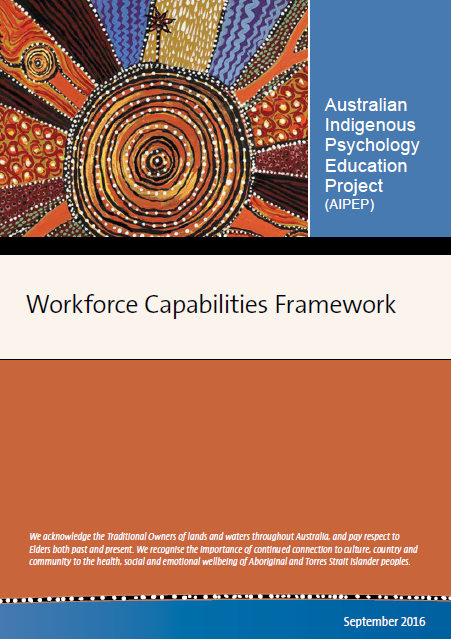
The objective of the AIPEP Workforce Capabilities Framework is to document the knowledge, skills and values required of psychologists working with Aboriginal and Torres Strait Islander peoples in order to build the capacity and competency of all psychology graduates to work appropriately and effectively with Aboriginal and Torres Strait Islander peoples.
Australian Indigenous Psychology Education Project Guidelines for Increasing the Recruitment, Retention and Graduation of Aboriginal and Torres Strait Islander Psychology Students

AIPEP Guidelines for Increasing the Recruitment, Retention and Graduation of Aboriginal and Torres Strait Islander Psychology Students.
What works in Aboriginal and Torres Strait Islander suicide prevention?

Suicide is a complex behaviour with many causes. For Aboriginal and Torres Strait Islander peoples there are specific cultural, historical, and political considerations that contribute to the high prevalence, and that require the rethinking of conventional models and assumptions.